
Emergency water removal Southgate: the ground it sits on
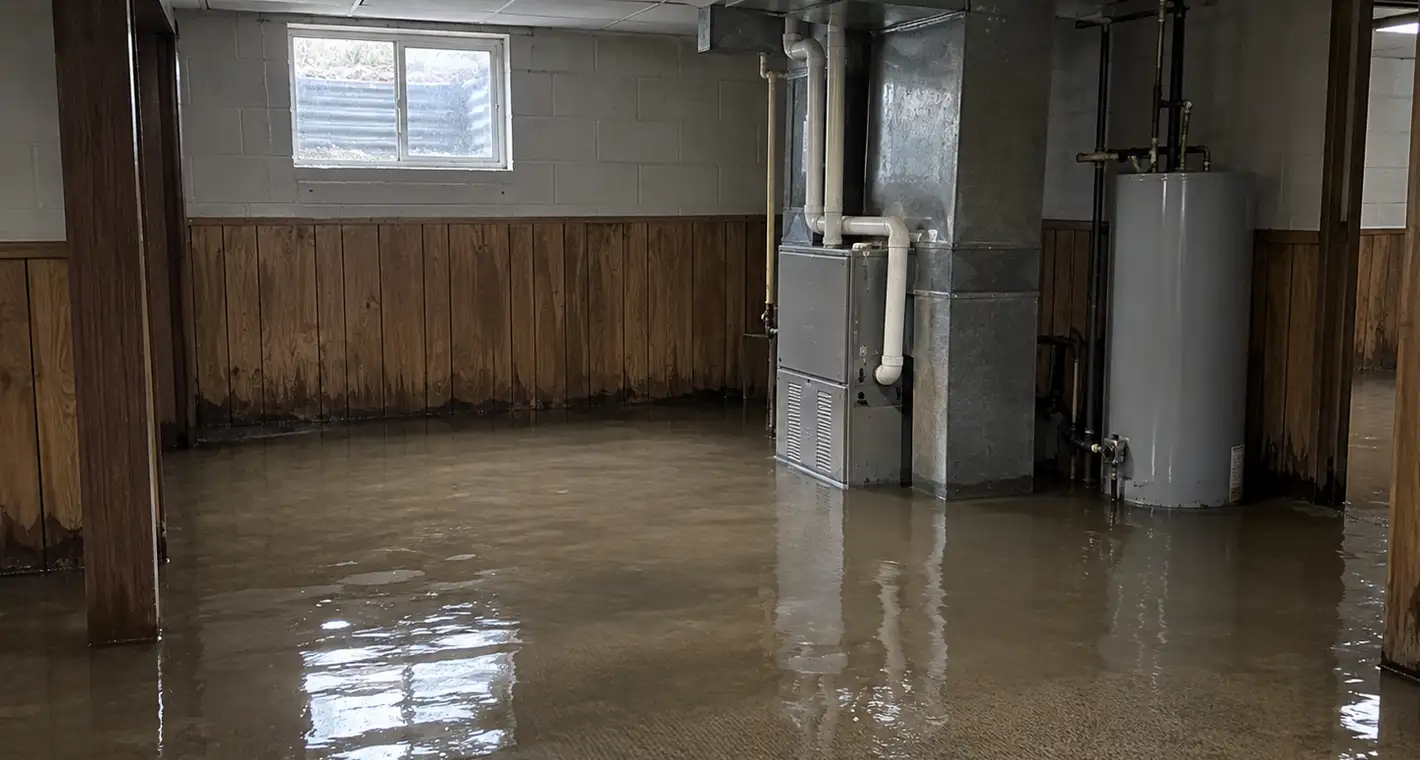
Southgate sits on flat Downriver lake plain between Lincoln Park and Trenton, with no natural relief to move water anywhere quickly. Southgate filled in mostly after the war, with about half its houses built in the 1940s and 1950s and a median build year of 1963.
Burst pipe cleanup Southgate: where the water comes from
Combined sewer surcharge on the older side
On the roughly 1,046 acres still served by one pipe, a heavy rain pushes street water into the same line that carries household waste. When that line fills, the flow reverses toward the buildings connected to it. The water arrives at the floor drain or the laundry standpipe, and because it has been in a sewer it is handled as contaminated even when it looks like rainwater.
Ground water on the separated side
Where the sewers are separated, a surcharge from the street is not the mechanism. What happens instead is that the clay saturates, the water table comes up, and pressure works against the slab and the base of the wall. It arrives slowly, spreads from the perimeter inward, and often recurs in the same corner every wet spring until the drainage outside the wall is addressed.
Flat ground with nowhere to shed
There is essentially no fall across Southgate. Water that lands on a lawn or a drive does not run off, it sits and soaks in, and clay slows the soaking. Grading that was adequate when a subdivision was new is often flat or reversed forty years later after settling and landscaping, and the first place that shows is the window well on the low side of the house.
Aging water heaters in finished rooms
Postwar basements that were finished in the 1980s often boxed in the mechanical space, leaving a water heater inside a closet with a floor and no drain. A tank that fails inside that closet puts water under the finished floor before anything is visible in the room, and the first sign is usually a soft spot in the carpet several feet away.
Before help arrives
- Shut the water off at the fixture or the main if you can reach it safely.
- Keep out of any room where water has reached outlets, cords, or the electrical panel.
- Lift furniture off wet carpet and move what you can to a dry floor.
- Photograph the damage and the failure point before anything is moved.
- Do not use a household vacuum to pick up standing water.
Sewage backup cleanup Southgate: the pipe under the street
Southgate is the clearest split on this site. Of its 2,489 acres in the Southgate-Wyandotte drainage district, roughly 1,046 are served by combined sewers and 1,443 by separate storm and sanitary lines. On the combined side a downpour can surcharge the pipe that also carries your sewage; on the separated side that mechanism does not exist and a wet basement means ground water, a lateral problem, or something inside the house. The neighborhood decides which conversation you are having.
Water extraction Southgate and drying what is left
The postwar half of the city has full basements with slabs poured on clay and no vapor barrier, so the floor itself gives up moisture into the room for days. Dehumidification is sized for the slab rather than for the puddle, and readings from the slab surface are taken alongside readings from the walls.
Mold remediation Southgate when drying came too late
Mold remediation in Southgate depends on which half of the city the house is in. On the combined side, growth follows contaminated backup water and the affected material comes out. On the separated side it is usually slow moisture from the slab and the wall, which shows up behind stored goods and on the back of anything set flat against masonry.
Water Damage Restoration Southgate MI: what providers handle
- Water Extraction & DryingWater pulled out of carpet, subfloor and wall cavities, then dried under daily meter readings.
- Flooded Basement CleanupWater below grade: a pump that stopped, seepage through the wall, or a drain that backed up.
- Sewage Backup CleanupDrain water treated as contaminated: containment, removal, cleaning and disinfection.
- Mold RemediationGrowth that took hold while a wet cavity stayed wet. Contained removal, not surface cleaning.
Areas covered in Southgate
Providers cover Southgate and the surrounding area, including the Trenton Road corridor, the Fort Street corridor, the Eureka Road corridor, the Dix-Toledo corridor, the Northline Road area and the Allen Road area.
ZIP codes: 48195.
Water Damage Restoration Southgate MI: questions homeowners ask
- Will my homeowners insurance cover water damage?
- It depends on the cause rather than the damage. Policies commonly cover sudden and accidental events such as a burst supply line, a failed water heater, or an appliance hose that lets go. Damage that developed gradually from a long-standing leak, and damage from surface flooding, are usually handled differently or excluded. Photograph everything before anything is moved, keep any failed part, and report the loss promptly.
- How do I know whether my Southgate street is combined or separated?
- The city's department of public services can tell you which system serves your address, and it is worth asking once and writing it down. From inside the basement the clue is the source: water arriving at the floor drain during heavy rain points at a combined sewer surcharge, while water arriving at the wall or the slab perimeter points at ground water regardless of which system you are on.
- The same corner floods every spring. Is that a plumbing problem?
- Usually not. A recurring wet corner in the same season is the signature of ground water and outside drainage: grade that falls toward the house, a downspout discharging next to the foundation, or a footing drain that is blocked or was never installed. Cleanup dries what is wet, but the recurrence stops only when the water is kept away from the wall.
- Is a wet slab in an unfinished basement worth calling about?
- If it is damp underfoot after a storm and dries on its own, that is a maintenance conversation. If there was standing water, or if the humidity in the room stays high for days, it is worth measuring, because a slab that keeps releasing moisture will grow mold on anything stored on it and will keep the framing in an adjacent finished area damp.