
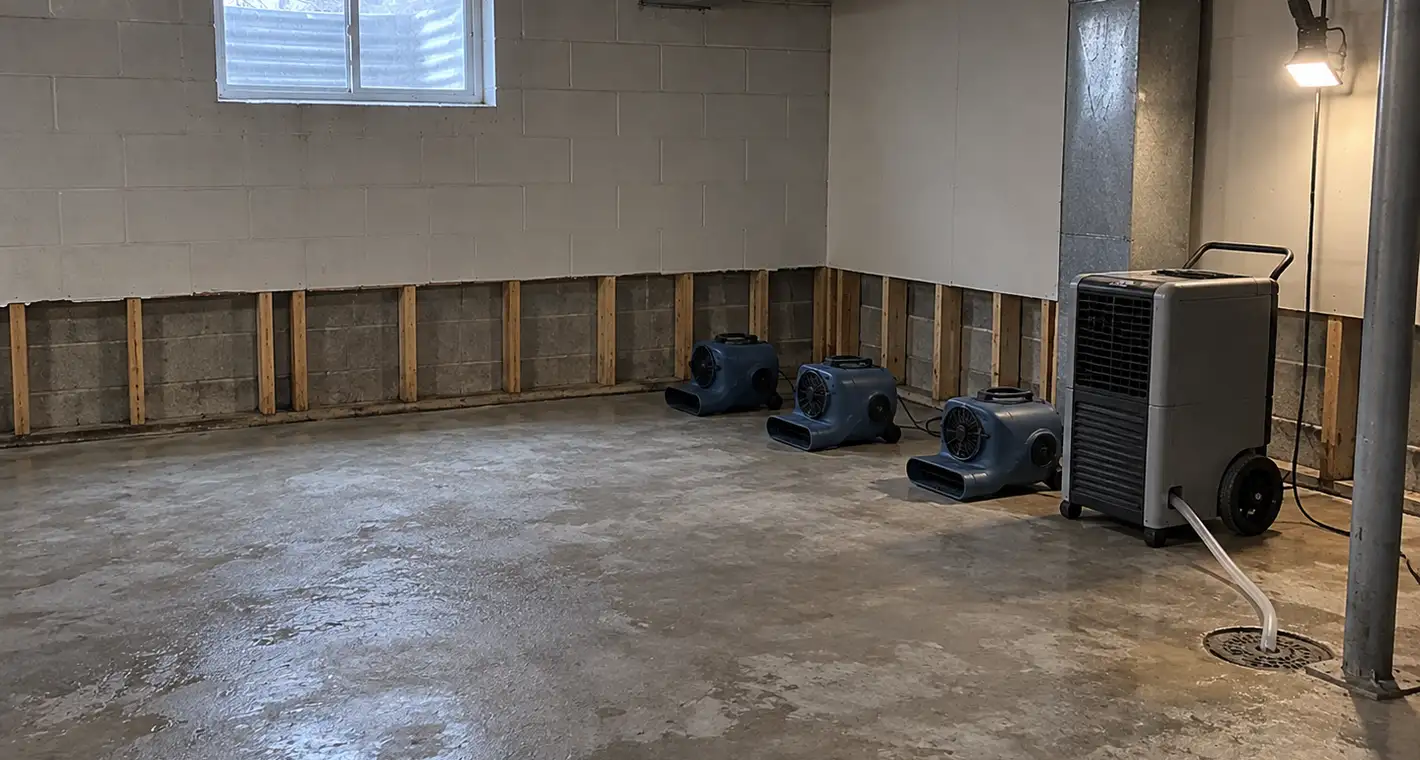
Emergency water removal before anything else
While standing water is present, everything else is slower and the wet area keeps growing. Bulk removal comes first, with equipment that draws water out of carpet and padding under vacuum instead of lifting it off the surface. On hard flooring the concern is what has already traveled beneath it, through seams in vinyl and laminate and into the subfloor.
In this region most of that work happens in a basement, because 62 percent of Michigan homes have one against 30 percent nationally. That changes the arithmetic. A basement slab and block walls hold water far longer than framing and drywall do, so every gallon pulled out mechanically is a gallon that does not have to be evaporated out of masonry and then condensed out of the air, which is much slower.
Structural drying in an old housing stock
A building holds water inside its materials, not merely on the surfaces you can see. Air movers are placed to break the thin layer of still, saturated air that forms against a wet surface; until that layer is disturbed, evaporation nearly stops, which is why a wet floor in a closed basement can stay wet for days. Dehumidifiers then take the released moisture out of the air. Without them the humidity in the space climbs and the water redeposits into materials that were dry, spreading the loss into rooms that were never touched.
What varies here is the assembly. On the older side of the region, where nearly half the houses in Wyandotte, Melvindale and Dearborn were built before 1940, walls are plaster over wood lath, which holds several times the water drywall does and releases it slowly. Postwar cities such as Woodhaven, Riverview and Romulus are drywall on dimensional framing over poured foundations, which dry on a predictable schedule. The same volume of water in the two produces very different jobs.
Cold weather changes the equipment
The heaviest losses in this region are not summer losses. A supply line splits in a January cold snap, the house is closed up, and the basement it drains into is at 50 degrees. Conventional refrigerant dehumidification loses capacity as the air gets colder, so drying a winter loss means bringing the space up to temperature and using low-grain refrigerant or desiccant equipment that still works there. Equipment chosen for a July basement and left running in a February one will hold readings flat for days while the invoice keeps growing.
Measurement rather than guesswork
A moisture meter is used on the affected material and on unaffected material of the same type elsewhere in the house, which establishes what normal means for that specific structure. A moisture meter reading on its own means little; the pair of readings is what carries information. Thermal imaging helps locate where water traveled, though it shows temperature difference rather than moisture and is used to aim the meter rather than replace it. Readings are logged on each visit, and equipment stays until the affected readings return to the baseline. A contained loss caught early commonly runs three to five days; plaster, hardwood and concrete take a week or more.
What gets dried and what comes out
Clean water caught quickly allows most of the structure to be dried in place. Carpet padding is usually removed regardless, because it holds a great deal of water and dries slowly enough to keep the carpet above it wet. Where water was contaminated, which in this region often means it came up through a floor drain, removal replaces drying for porous material. Saturated insulation is a routine example: it stops working as insulation and holds water against the framing behind it.
Water Extraction Dearborn MI: cities covered
- Water Extraction Dearborn
- Water Extraction Dearborn Heights
- Water Extraction Wyandotte
- Water Extraction Melvindale
- Water Extraction Lincoln Park
- Water Extraction Allen Park
- Water Extraction Southgate
- Water Extraction Taylor
- Water Extraction Livonia
- Water Extraction Westland
- Water Extraction Garden City
- Water Extraction Wayne
- Water Extraction Romulus
- Water Extraction Trenton
- Water Extraction Riverview
- Water Extraction Woodhaven
Water Extraction Dearborn MI: questions homeowners ask
- How is extraction different from mopping or shop-vacuuming?
- Extraction units pull water out of carpet and padding under vacuum rather than lifting it off the surface. Most of the water in a carpeted room is in the padding beneath, and surface methods leave it there. A shop vacuum also has no way to reach water that has already moved under the tack strip into the wall base, which in a basement is where most of it goes.
- Why does drying take longer in a Michigan winter?
- Cold slows evaporation and it also limits equipment. A conventional refrigerant dehumidifier loses capacity as the space gets colder, which is why a January loss in an unheated basement is dried with low-grain refrigerant or desiccant equipment and with the space brought up to temperature first. A burst-pipe loss in February and the same loss in July are not the same job.
- Does plaster dry the same way drywall does?
- No, and in this region that matters. Nearly half the houses in Wyandotte, Melvindale and Dearborn predate 1940 and are plaster over wood lath. Plaster holds far more water than drywall and gives it up slowly, and the lath behind it holds water of its own. A plaster wall that reads dry on the face can still be wet in the keys behind it, so readings are taken through the assembly.
- How is drying confirmed rather than assumed?
- Meters are used on the affected material and on the same material elsewhere in the building where it stayed dry. That second reading is the baseline for that structure, and it differs between a 1925 house and a 1979 one. Readings are logged daily and equipment stays until the affected material matches the baseline, so the schedule follows the numbers rather than a fixed count of days.
- Can equipment be pulled early to save money?
- It can, and it usually costs more later. Material left above its normal moisture keeps holding water inside the assembly, and that is the condition mold grows in. Ending drying early is the most common reason a loss that looked finished comes back weeks later as a remediation job in the same wall.