
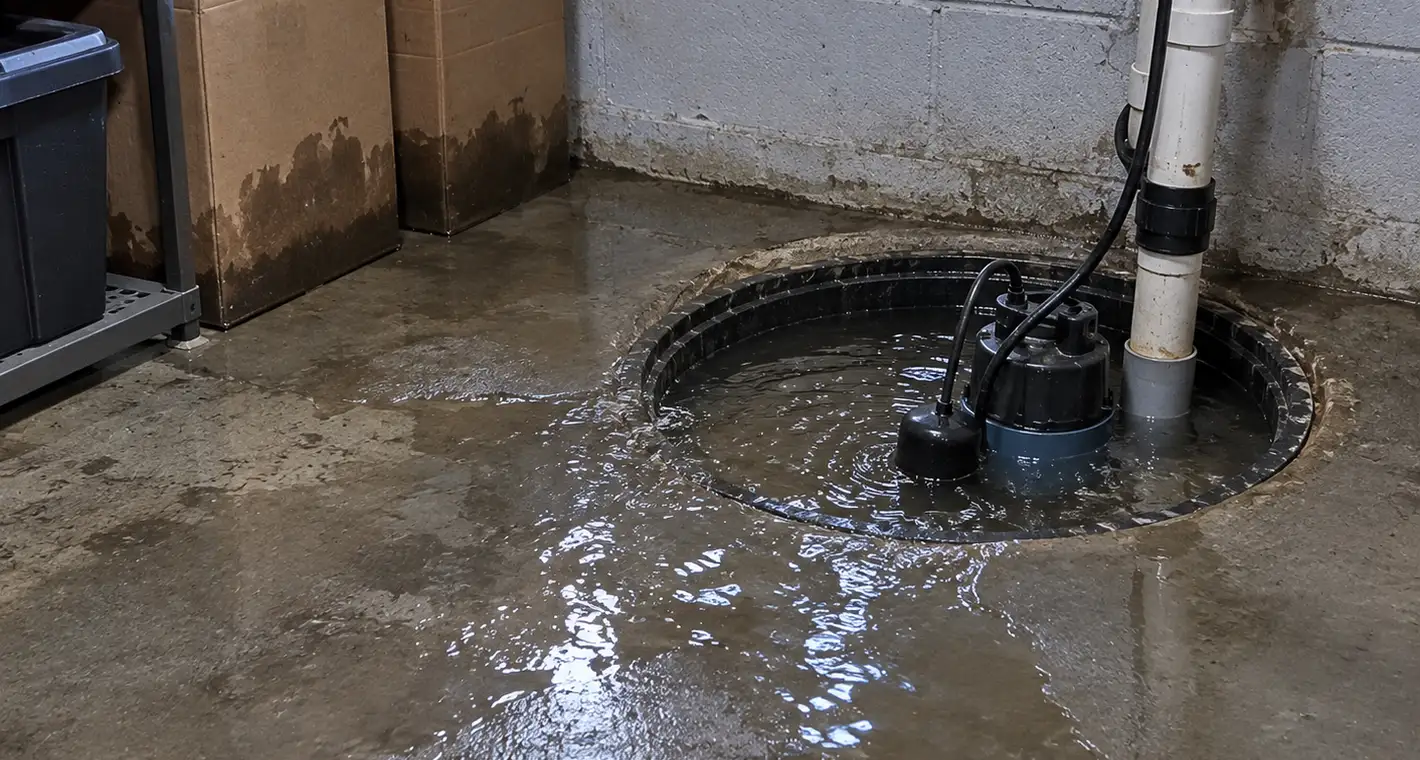
Four ways water gets into a basement here
A flooded basement in this region is not one event with one cause. Water arrives up through the floor drain when a sewer surcharges, around the sump pit when the pump stops, along the base of a wall when saturated clay presses against it, and down a stairwell or a window well when surface water has nowhere else to go. All four look similar once there is an inch on the floor, and all four call for different work. Establishing which one happened is the first thing done on site, because it decides whether the water is treated as clean or contaminated.
The pump and the power go out together
A quarter of Michigan households have gone 24 hours or longer without electricity, the worst figure among the states this network covers. That outage does not arrive on a calm day. It arrives with the same storm that raises the water table, at the hour the sump pump is doing the most work it does all year. A pump on house current is simply off during that window, and in a house where the footing drain is the drainage, there is no passive path for the water to take. The pit fills, then the slab edge, then the room.
That is why a battery or water-powered backup is the single change that addresses the local failure mode directly, and why testing the primary pump twice a year matters more than its age. The failure that floods basements is usually a stuck float on a working pump rather than a burned-out motor.
Combined sewers and where they still are
Whether a downpour can push sewage back into your basement depends on the pipe under your street. Wyandotte is served entirely by combined sewers across all 2,772 acres of the city. Southgate is split, with roughly 1,046 acres combined and 1,443 acres on separate storm and sanitary lines. Dearborn Heights has a 548-acre combined district with a county retention basin on Hines Drive holding 2.7 million gallons of overflow. Dearborn has been dividing its own single-line system in two under a federal mandate. In Livonia, Garden City, Westland, Wayne and Romulus there are no combined sewer regulators at all, and a wet basement there points somewhere other than the street.
What comes out of a finished basement
Most basements in these cities have been finished at least once. That finish is what holds the water: carpet and pad on a slab with no vapor barrier, drywall or paneling fastened to furring against block, and insulation in the stud bays behind it. Pad comes out in nearly every case because it holds water and keeps the carpet above it wet. The bottom band of drywall is cut so air can reach the cavity. What stays depends on the category of the water and how many hours it sat before anyone started.
Contents are handled at the same time. Cardboard, particle board furniture and anything paper-faced absorb water and start growing quickly in a warm basement, and they are also the easiest things to remove on the first day. Mechanical equipment sitting on the floor, the furnace, the water heater and the panel, is a safety question before it is a cleanup question and is left alone until the power to it has been dealt with.
Basement Flood Cleanup Dearborn MI: what the first hours look like
Extraction of standing water, then removal of pad and any material already past saving, then air movers and dehumidification set for the volume of the space rather than the size of the puddle. Readings are taken the same day and repeated daily, on the slab, on the walls and in the framing, and equipment stays until they match dry material elsewhere in the same house. Where the water came from a drain, cleaning and disinfection of the hard surfaces happens before drying rather than after.
Basement Flood Cleanup Dearborn MI: cities covered
- Flooded Basement Cleanup Dearborn
- Flooded Basement Cleanup Dearborn Heights
- Flooded Basement Cleanup Wyandotte
- Flooded Basement Cleanup Melvindale
- Flooded Basement Cleanup Lincoln Park
- Flooded Basement Cleanup Allen Park
- Flooded Basement Cleanup Southgate
- Flooded Basement Cleanup Taylor
- Flooded Basement Cleanup Livonia
- Flooded Basement Cleanup Westland
- Flooded Basement Cleanup Garden City
- Flooded Basement Cleanup Wayne
- Flooded Basement Cleanup Romulus
- Flooded Basement Cleanup Trenton
- Flooded Basement Cleanup Riverview
- Flooded Basement Cleanup Woodhaven
Basement Flood Cleanup Dearborn MI: questions homeowners ask
- Where did the water actually come from?
- There are four routes into a basement here and they call for different work. Up through the floor drain means the sewer surcharged and the water is contaminated. Around the sump pit means the pump stopped or the discharge is blocked. Along the base of a wall means ground water in saturated clay. Down a stairwell or window well means surface water. Which one it was decides what can be dried and what has to be removed.
- The power went out and my basement flooded. Is that covered?
- It depends on the policy and on what failed. Many policies treat sump pump failure and water backup as an endorsement rather than standard coverage, and the endorsement often has its own limit. It is worth reading before a storm rather than after one. Photograph the water line, the pump and the pit before anything is moved, and keep the failed pump if one is replaced.
- How much of a finished basement usually comes out?
- Less than owners expect from clean water and more than they expect from a sewer backup. With clean water caught early, often only the carpet pad and the bottom few inches of drywall. With water that came up a drain, porous material in the wet zone is removed: pad, carpet, the lower band of drywall, any insulation behind it, and stored goods that absorbed it.
- Why does the basement stay humid after the floor is dry?
- Because concrete and block hold water inside the material and give it up slowly. A slab and the bottom courses of a foundation wall can keep releasing moisture into the room for days after the last visible water is gone. That is why drying is measured in the material rather than judged by how the floor feels, and why dehumidification usually runs longer in a basement than it would upstairs.
- Can a basement that floods every spring be dried permanently?
- Drying handles this event; it does not change the ground outside. A basement that takes water in the same place every wet season is telling you about grading, downspouts, a footing drain, or a pump that cannot keep ahead of the water table. Cleanup should be followed by a look at the outside of the wall, otherwise the next spring produces the same call.