
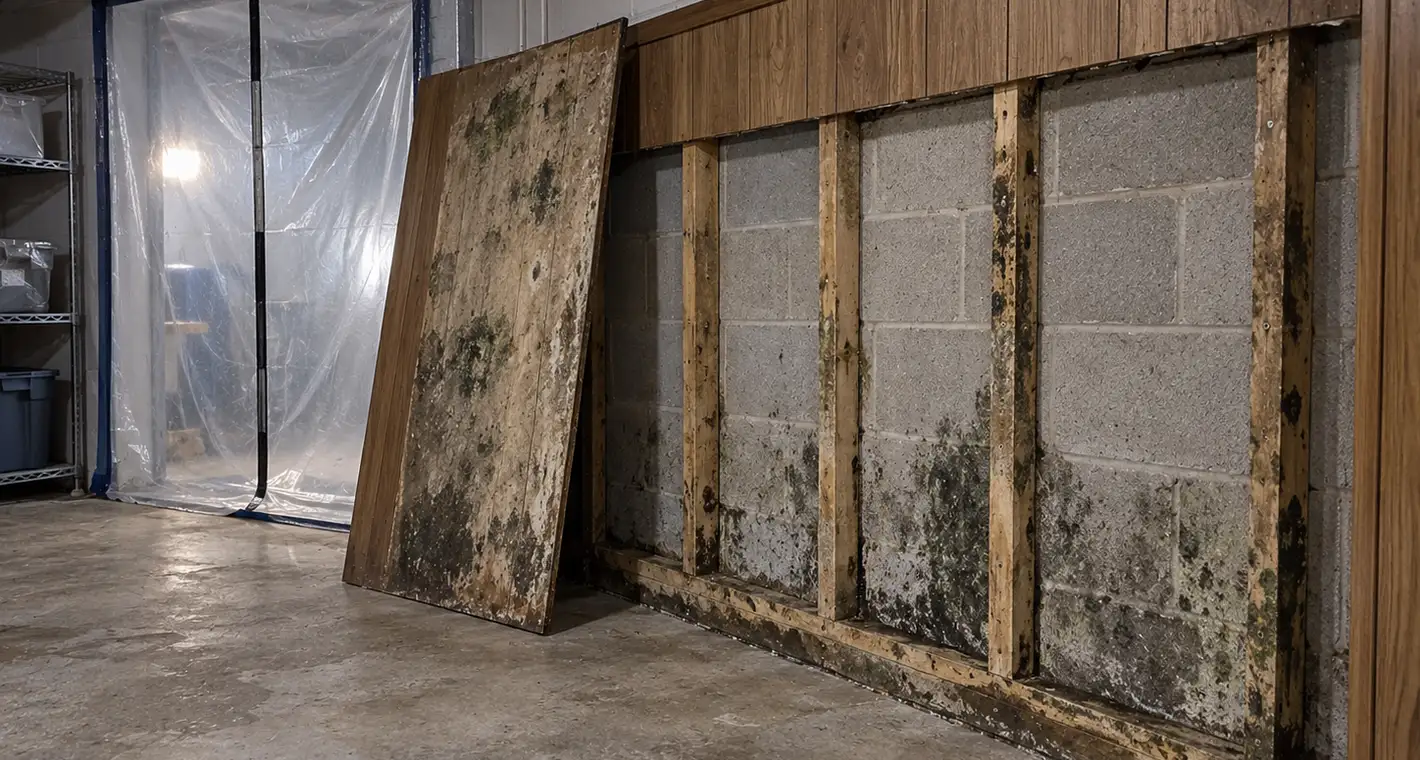
A humid summer and a dry winter, in the same basement
This is a humid continental climate, and for mold that produces two opposite seasons in one house. From June through September the dew point outside sits in the 60s for weeks at a time while an unconditioned basement holds close to the same temperature. Moisture from the air condenses on the slab and on the bottom courses of the wall, and material sitting against that masonry stays damp without a drop of water ever having leaked. The instinct to open a basement window in August is exactly wrong here: it brings the wet air in.
Winter reverses it. Cold outdoor air holds almost no moisture, so a heated house in January is dry enough that a wet cavity will actually give up water if air can reach it. That is why a burst-pipe loss in February dries faster than an identical loss in July, and why the mold calls cluster in late summer rather than after the winter events that caused the most damage.
Where the moisture comes from in these houses
- Slabs poured without a vapor barrier, which is most basements built before the 1970s here
- Block foundation walls that wick ground water upward from saturated clay
- Paneling on furring strips, the standard 1970s basement finish, holding damp air against masonry
- Storage and cardboard stacked against a cold exterior wall
- Supply or drain leaks inside a wall that ran for weeks before a stain appeared
- Sump pits left uncovered, evaporating into the room continuously
In practice the finding is nearly always behind something rather than on it. Paneling, drywall, insulation and shelving all hide the face that is against the wall, and that face is where growth starts. A basement that looks clean and smells musty is a basement where the growth is on the side nobody has seen.
Containment before removal
Removing affected material disturbs spores. Without sheeting and negative air pressure holding the work zone below the pressure of the rest of the house, that disturbance travels on ordinary air movement, and a contained problem becomes a distributed one. Containment is not paperwork; it is the difference between remediating one wall and remediating a house.
Affected porous material is then removed under that containment and bagged before it leaves the zone. Non-porous surfaces, concrete, block, tile and framing, are cleaned rather than removed, because growth on them is on the surface where it can be reached. HEPA filtration runs through the work and after it, and the space is cleaned rather than simply emptied.
Mold removal Dearborn MI: correcting what caused it
Remediation that removes growth and leaves the moisture in place is work that gets repeated. In this region the correction is often not a repair at all: it is a properly sized dehumidifier running from June to September, a cover on the sump pit, downspouts extended away from the foundation, and storage kept off the floor and away from exterior walls. Where there is a leak or a drainage failure behind it, that gets fixed first and the drying is verified with readings before anything is rebuilt.
Mold Remediation Dearborn MI: cities covered
- Mold Remediation Dearborn
- Mold Remediation Dearborn Heights
- Mold Remediation Wyandotte
- Mold Remediation Melvindale
- Mold Remediation Lincoln Park
- Mold Remediation Allen Park
- Mold Remediation Southgate
- Mold Remediation Taylor
- Mold Remediation Livonia
- Mold Remediation Westland
- Mold Remediation Garden City
- Mold Remediation Wayne
- Mold Remediation Romulus
- Mold Remediation Trenton
- Mold Remediation Riverview
- Mold Remediation Woodhaven
Mold Remediation Dearborn MI: questions homeowners ask
- How quickly can mold establish after water damage?
- Given moisture, an organic food source such as paper-faced drywall, and ordinary indoor temperatures, growth can begin within about two days. That window is why drying is treated as urgent rather than something that waits for the weekend. In a warm basement in July the window is at the short end of that range, because the conditions are already close to what growth needs.
- Why does my basement smell musty in August with no leak at all?
- Because the air outside is wetter than the basement is cold. Summer dew points in this region sit in the 60s, and an unconditioned basement runs at roughly the same temperature, so moisture from outdoor air condenses on the slab and the lower walls. No pipe has failed and nothing has flooded, but the material is damp enough to grow. Opening a window in that weather makes it worse, not better.
- Should I have the air tested first?
- Testing has a place but it is not always the first step. Where growth is visible and the water source is known, a test rarely changes what has to be done. It is more useful where there is an odor with no visible growth, where the extent behind an assembly is unclear, or where independent verification after the work is wanted. Verification after remediation is normally done by someone other than the party who performed it.
- Is black mold different from the rest?
- Black mold is a colloquial term rather than a category of work. Several species look dark, one of which gets most of the attention, and identifying which one is present does not change the method: the material it is growing on is porous or it is not, and the moisture behind it is corrected or it is not. Remediation is the same whatever the color turns out to be.
- Can I clean it myself with bleach?
- On a small patch of hard, non-porous surface such as tile or glass, ordinary cleaning is often reasonable. On porous material it is not: growth extends into the material where a surface treatment cannot reach, and wiping disturbs spores into the air of the rest of the house. Bleach on a porous surface also adds water, which is the thing feeding the problem in the first place.
- Will it come back?
- It will if the moisture that caused it is still there. Remediation removes what has grown, but the condition that allowed it has to be corrected as well: the leak repaired, the drainage outside the wall fixed, the humidity brought down, the assembly properly dried. In this region the correction is often a dehumidifier running through the summer rather than a repair at all.