
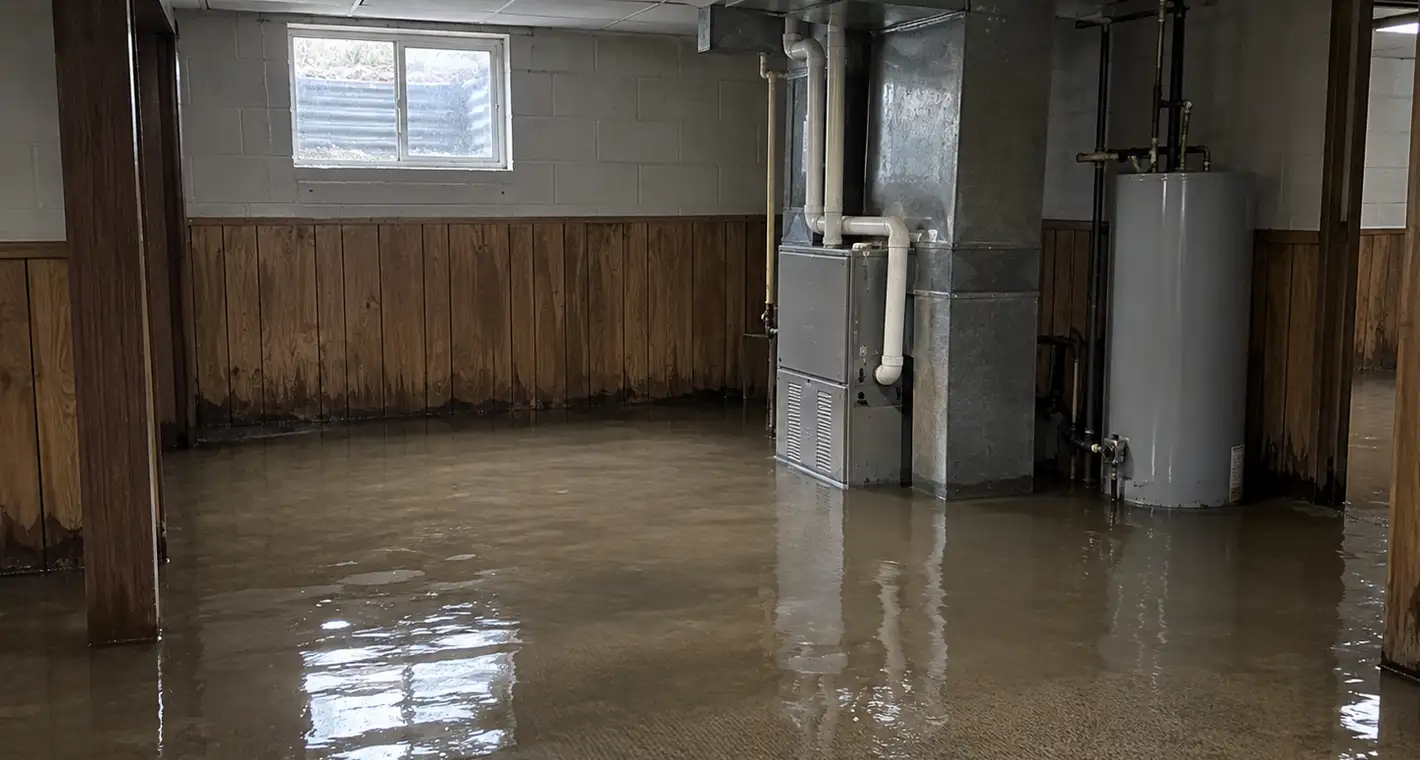
Emergency water removal Westland: the ground it sits on
Westland sits between the Middle Rouge and Hines Park at the north end and the head of the Ecorse Creek drainage at the south, with Tonquish Creek crossing the middle toward Nankin Mills. Westland's median build year is 1969, but the range is wide: wartime housing from 1942 in Norwayne at one end and 1980s subdivisions at the other.
Burst pipe cleanup Westland: where the water comes from
Two watersheds, one city
The north end drains to the Middle Rouge through Hines Park and Tonquish Creek; the south end drains toward Ecorse Creek. A storm that fills one does not necessarily fill the other, which is why flooding reports in Westland are so uneven from one heavy rain to the next. Knowing which side of the city you are on explains most of the difference between you and a neighbor a mile away.
Norwayne's shallow foundations
Norwayne was built in 1942 and 1943 as defense worker housing, quickly and to a modest standard. The foundations are shallow, the below-grade space is low, and the water table in that part of the city sits close to it. Water arrives at the floor rather than partway up a wall, and the material at risk is the framing sill and the subfloor rather than a finished basement.
Tonquish Creek through the middle
Tonquish Creek crosses the city and joins the Rouge near Nankin Mills, and the streets that back onto it take water when the creek comes up. It is a small channel with a large drainage area behind it in Canton and Plymouth, so it rises quickly and falls quickly, and the damage it does is often finished within a couple of hours.
Aging supply lines in mixed-age stock
A city with houses from 1942 through the 1980s has plumbing of every vintage in it, including polybutylene in a slice of the later stock and original galvanized in the earliest. Failures do not follow one pattern. What they share is location: the runs through unheated garages, additions and crawl spaces are the ones that split in a January cold snap.
Before help arrives
- Shut the water off at the fixture or the main if you can reach it safely.
- Keep out of any room where water has reached outlets, cords, or the electrical panel.
- Lift furniture off wet carpet and move what you can to a dry floor.
- Photograph the damage and the failure point before anything is moved.
- Do not use a household vacuum to pick up standing water.
Sewage backup cleanup Westland: the pipe under the street
Westland's sanitary flow runs into the Rouge Valley system, which has no combined sewer regulators here, so street water and sewage travel separately. But Westland is also one of the nine cities in the North Branch Ecorse Creek drainage district, and the county has described that channel as severely limited in capacity. The result is a city where the sewer is rarely the cause and the drain almost always is: storm water that cannot leave stays in the ground.
Water extraction Westland and drying what is left
The Norwayne houses are small, on shallow foundations with low basements or crawl space, and they dry differently from the rest of the city: less volume, less airflow, and a floor much closer to the water table. Elsewhere Westland is standard postwar basement work. The plan changes by neighborhood more than it does by the size of the loss.
Mold remediation Westland when drying came too late
Mold remediation in Westland is a crawl space job as often as a basement job, because the older wartime sections were not all built with full basements. A crawl with a dirt floor and no vapor barrier stays humid on its own, and after any water event the framing above it is what grows, out of sight from the living space.
Water Damage Restoration Westland MI: what providers handle
- Water Extraction & DryingWater pulled out of carpet, subfloor and wall cavities, then dried under daily meter readings.
- Flooded Basement CleanupWater below grade: a pump that stopped, seepage through the wall, or a drain that backed up.
- Sewage Backup CleanupDrain water treated as contaminated: containment, removal, cleaning and disinfection.
- Mold RemediationGrowth that took hold while a wet cavity stayed wet. Contained removal, not surface cleaning.
Areas covered in Westland
Providers cover Westland and the surrounding area, including Norwayne, the Nankin Mills area, the Cherry Hill Road corridor, the Wayne Road corridor, the Ford Road corridor and the Hawthorne Valley area.
ZIP codes: 48185, 48186.
Water Damage Restoration Westland MI: questions homeowners ask
- Will my homeowners insurance cover water damage?
- It depends on the cause rather than the damage. Policies commonly cover sudden and accidental events such as a burst supply line, a failed water heater, or an appliance hose that lets go. Damage that developed gradually from a long-standing leak, and damage from surface flooding, are usually handled differently or excluded. Photograph everything before anything is moved, keep any failed part, and report the loss promptly.
- My neighbor a mile away flooded and I did not. Is that normal in Westland?
- It is, and it usually comes down to which watershed you are in. The north of the city drains to the Rouge and Tonquish Creek, the south toward Ecorse Creek, and a storm can overwhelm one while the other handles it. Elevation differences of two or three feet also matter far more here than they sound, because the ground is flat enough that small differences decide where water sits.
- What is different about water damage in a Norwayne house?
- Scale and depth. These are small houses on shallow foundations, so a few inches of water reaches structural framing and subfloor rather than the finish on a basement wall. Drying is faster because there is less volume, but the material at risk is more important, and a crawl space under part of the house has to be checked even when the rooms above look dry.
- Does a crawl space need to be dried the same way a basement does?
- It needs the same measurements and different equipment. A crawl has no airflow of its own, low headroom, and often a dirt floor that keeps feeding moisture upward. Drying it means sealing it off from the outside air, putting equipment inside rather than at the hatch, and checking the framing above rather than the ground below, because that is where the damage is.