
Emergency water removal Livonia: the ground it sits on
Livonia occupies about 36 square miles of gently rolling ground north of the Middle Rouge, with Hines Park and the river forming its southern boundary. Livonia is the postwar suburb of this group: a median build year of 1964, 57 percent of the stock from the 1940s and 1950s, and 87 percent of it owner-occupied.
Burst pipe cleanup Livonia: where the water comes from
The Middle Rouge along the south edge
The Middle Rouge and Hines Park run the length of Livonia's southern boundary, and the parkway was laid out to take the river's overflow. When the gauge downstream at Dearborn Heights comes up, Hines Drive closes. The homes above that corridor are not in the river's way, but the ground water table beneath them rises with it, and that is what reaches the slab.
Fifty years of settled grading
Subdivisions built in the 1950s and 1960s were graded to drain away from the houses. Half a century of settlement, added patios, raised beds and new driveways has flattened or reversed that fall on a large share of lots. The clay underneath never drained well to begin with, so water that used to leave now collects at the foundation and works down the wall.
Original sump systems in clay
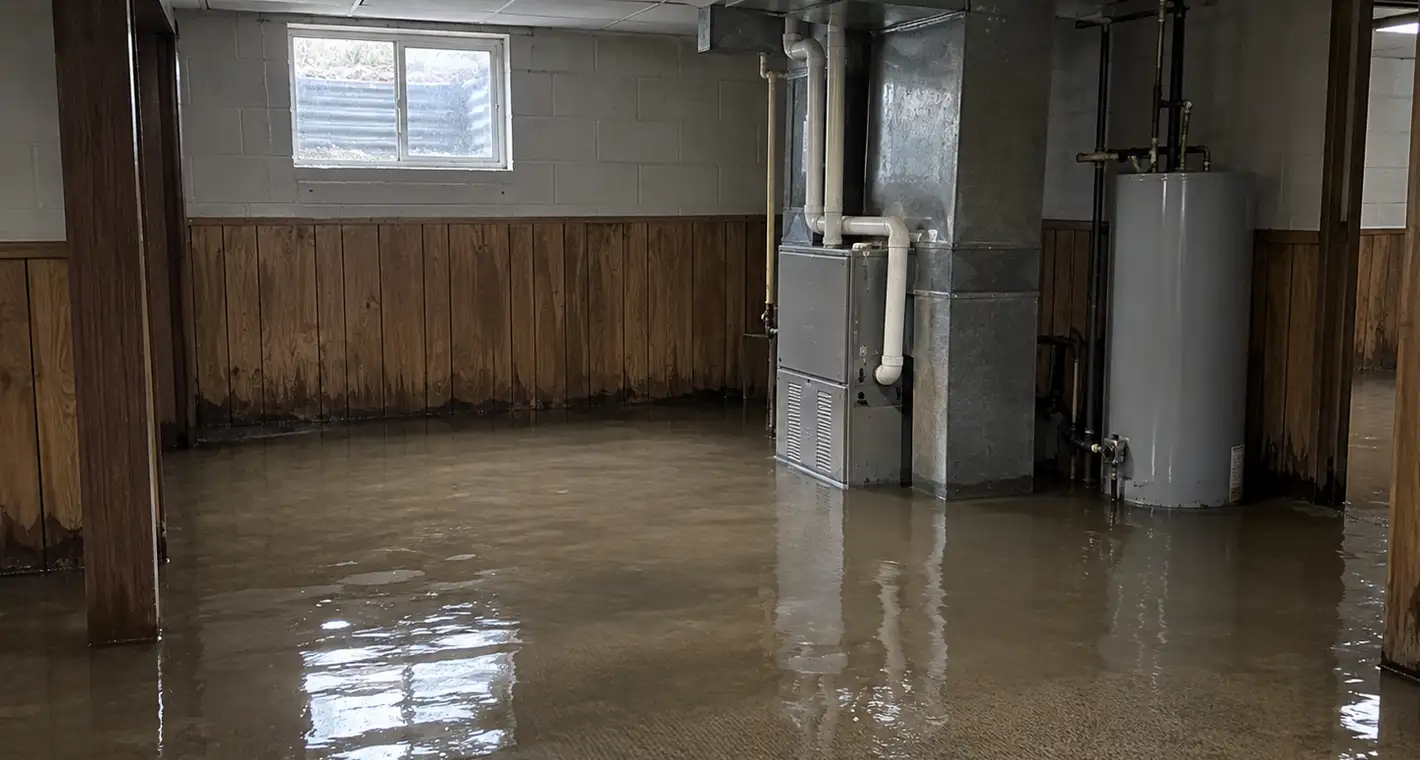
Clay keeps water against a foundation for days after a storm, which is exactly the load a sump pump was installed to carry. Many Livonia pits still hold the original pump or its first replacement, on house current, with a discharge that ends a few feet from the wall. Any one of those three is enough to put water on a finished floor during a long rain.
Second-floor laundry and upstairs baths
Larger Livonia houses put the laundry and two or three baths upstairs, which changes what a failure costs. A supply hose that lets go on the second floor sends water through the ceiling, along the joists, down inside the wall cavities and into the basement, damaging three levels from one failure. The visible ceiling stain is usually the smallest part of it.
Before help arrives
- Shut the water off at the fixture or the main if you can reach it safely.
- Keep out of any room where water has reached outlets, cords, or the electrical panel.
- Lift furniture off wet carpet and move what you can to a dry floor.
- Photograph the damage and the failure point before anything is moved.
- Do not use a household vacuum to pick up standing water.
Sewage backup cleanup Livonia: the pipe under the street
Livonia's sanitary flow goes into the Rouge Valley Sewage Disposal System, and the county's combined sewer overflow regulators in that system are in Dearborn Heights, Inkster and Redford, not here. Storm water leaves separately, through county drains toward the Rouge. That rules out the single most common Downriver mechanism: a heavy rain does not push street water back up your floor drain. What it leaves behind is ground water, laterals, and failures inside the house.
Water extraction Livonia and drying what is left
Basements here are large, poured, and finished more often than not, frequently with a wet bar or a full second living area added in the 1990s. The finish is newer than the house, which means drywall and carpet rather than paneling, and drywall wicks. Cutting a few inches above the water line and drying the cavity is usually faster and cheaper than trying to dry a wall from the face.
Mold remediation Livonia when drying came too late
Mold remediation in Livonia most often follows a slow supply leak rather than a flood: a line behind a finished wall, or a failed hose in a second-floor laundry that ran into the ceiling below. By the time a stain appears the cavity has been wet for weeks, and the affected material is removed under containment rather than dried.
Water Damage Restoration Livonia MI: what providers handle
- Water Extraction & DryingWater pulled out of carpet, subfloor and wall cavities, then dried under daily meter readings.
- Flooded Basement CleanupWater below grade: a pump that stopped, seepage through the wall, or a drain that backed up.
- Sewage Backup CleanupDrain water treated as contaminated: containment, removal, cleaning and disinfection.
- Mold RemediationGrowth that took hold while a wet cavity stayed wet. Contained removal, not surface cleaning.
Areas covered in Livonia
Providers cover Livonia and the surrounding area, including Rosedale Gardens, Coventry Gardens, Clements Circle, Castle Gardens, Kimberly Oaks and the Newburgh Road corridor.
ZIP codes: 48150, 48152, 48154.
Water Damage Restoration Livonia MI: questions homeowners ask
- Will my homeowners insurance cover water damage?
- It depends on the cause rather than the damage. Policies commonly cover sudden and accidental events such as a burst supply line, a failed water heater, or an appliance hose that lets go. Damage that developed gradually from a long-standing leak, and damage from surface flooding, are usually handled differently or excluded. Photograph everything before anything is moved, keep any failed part, and report the loss promptly.
- Livonia has separated sewers. Why is my basement still wet?
- Separated sewers remove one cause, not all of them. What is left is ground water pressing on the wall and slab through saturated clay, a sanitary lateral restricted by roots, a sump system that cannot keep up or has no power, and failures inside the house. In practice most Livonia losses are the last two, which is good news: both are fixable at the house rather than at the street.
- There is a stain on the basement ceiling but no water anywhere. What now?
- That is usually a supply line or a drain above it, and it has been leaking longer than the stain suggests. The material around it is wet even where it looks dry, so a meter finds the extent before anything is opened. Shut the water to that fixture if you can identify it, and leave the ceiling alone until someone has read the moisture, because opening it releases whatever is above.
- Is drying a large Livonia basement different from a small one?
- The physics are the same but the equipment is not. A big open basement needs enough dehumidification to hold the whole volume at a low grain level, and enough air movers to keep every wet surface in moving air rather than only the ones near the middle. Undersizing shows up as a room that seems to be drying while the far corner stays wet for a week.