
Emergency water removal Garden City: the ground it sits on
Garden City covers under six square miles of flat ground between Westland and Inkster, laid out on the long narrow lots that gave the city its name. Two thirds of Garden City was built in the 1940s and 1950s on lots platted a generation earlier, giving a median build year of 1956 and a very consistent housing stock.
Burst pipe cleanup Garden City: where the water comes from
Deep lots and long roof runs
The original plats gave these houses long narrow lots, and the drainage that came with them was informal. Downspouts on many of the older houses still discharge within a foot or two of the foundation, which puts the entire roof area of a storm into the ground directly against the wall. In clay that water does not leave, it presses.
Block walls without drain tile
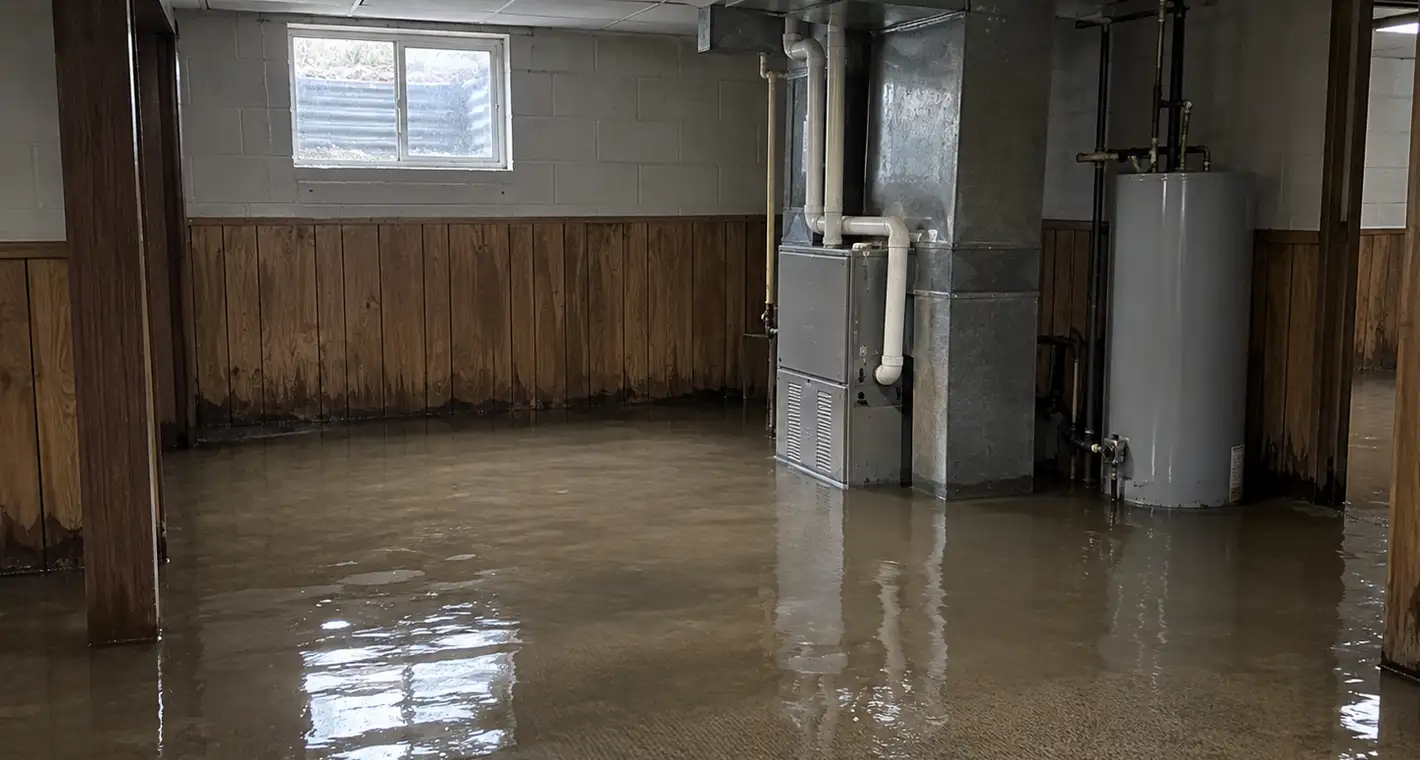
Foundations poured in the early 1950s frequently went in without a perimeter drain at the footing. The block cores fill from the outside, water travels down inside the wall, and it enters the room at the joint where the wall meets the slab. Seepage of this kind arrives slowly, along a stretch of wall rather than at a point, and it repeats every time the ground saturates.
Clay that will not take the rain
The lacustrine clay under this part of Wayne County percolates very slowly, and after a heavy rain the backfill around a foundation stays saturated for days. That is the whole mechanism for most Garden City basement water: the storm is over, the street is dry, and the ground around the house is still holding what fell, pressing on a wall that has no drain behind it.
Sanitary laterals of the same vintage
Every house on a Garden City block was built within a few years of every other, which means the clay tile laterals under them are the same age and failing on the same schedule. Root intrusion at the joints is the usual finding. A restricted lateral does not back up on a normal day, only when infiltration from a heavy rain adds to the household flow.
Before help arrives
- Shut the water off at the fixture or the main if you can reach it safely.
- Keep out of any room where water has reached outlets, cords, or the electrical panel.
- Lift furniture off wet carpet and move what you can to a dry floor.
- Photograph the damage and the failure point before anything is moved.
- Do not use a household vacuum to pick up standing water.
Sewage backup cleanup Garden City: the pipe under the street
Garden City is in the Rouge Valley system, and Wayne County's combined sewer regulators in that system are in Dearborn Heights, Inkster and Redford rather than here. Sewage and storm water leave the city in separate pipes. That removes the mechanism that fills Downriver basements during a downpour and leaves the ones that belong to the lot itself: saturated clay, a footing drain that no longer works, and roof water put down beside the wall.
Water extraction Garden City and drying what is left
The houses are consistent enough that the losses repeat: a full basement, block walls, a slab without a vapor barrier, and a finished half added later. Because the stock is so uniform, drying plans here are largely a question of how much of the finish comes out, and that is decided by whether the water was clean and how many hours it sat.
Mold remediation Garden City when drying came too late
Mold remediation in Garden City usually starts with what was stored against the wall. In a house with a deep lot and a small footprint the basement carries decades of storage, and boxes stacked to a block wall trap moisture behind them. The wall itself cleans up; the contents against it are usually what has to go.
Water Damage Restoration Garden City MI: what providers handle
- Water Extraction & DryingWater pulled out of carpet, subfloor and wall cavities, then dried under daily meter readings.
- Flooded Basement CleanupWater below grade: a pump that stopped, seepage through the wall, or a drain that backed up.
- Sewage Backup CleanupDrain water treated as contaminated: containment, removal, cleaning and disinfection.
- Mold RemediationGrowth that took hold while a wet cavity stayed wet. Contained removal, not surface cleaning.
Areas covered in Garden City
Providers cover Garden City and the surrounding area, including the Ford Road corridor, the Cherry Hill Road corridor, the Middlebelt Road area, the Merriman Road area, the Maplewood area and the Warren Road corridor.
ZIP codes: 48135.
Water Damage Restoration Garden City MI: questions homeowners ask
- Will my homeowners insurance cover water damage?
- It depends on the cause rather than the damage. Policies commonly cover sudden and accidental events such as a burst supply line, a failed water heater, or an appliance hose that lets go. Damage that developed gradually from a long-standing leak, and damage from surface flooding, are usually handled differently or excluded. Photograph everything before anything is moved, keep any failed part, and report the loss promptly.
- Where should a downspout discharge on a Garden City lot?
- Far enough from the wall that the water is outside the backfill zone, which in practice means several feet and onto ground that falls away from the house. Extensions are inexpensive and they address the single biggest controllable source of water against these foundations. On a deep lot there is usually room to run them well clear, which is not true everywhere in this region.
- Seepage shows along the whole wall, not one crack. Is that worse?
- It is a different problem, not necessarily a worse one. A single crack is a defect in the wall; seepage along a length of it is the wall doing what an undrained block wall in saturated clay does. Repairing a crack will not change it. What changes it is reducing the water in the ground outside: grading, downspouts, and if necessary a drain at the footing.
- Does the same repeat leak have to be reported to insurance every time?
- Report each loss you intend to claim, and document it the same way each time. Insurers treat sudden and accidental events differently from damage that has developed gradually, and repeated seepage from ground water is usually in the second category. Knowing that in advance is better than finding out after the cleanup, because it changes what you are paying for yourself.