
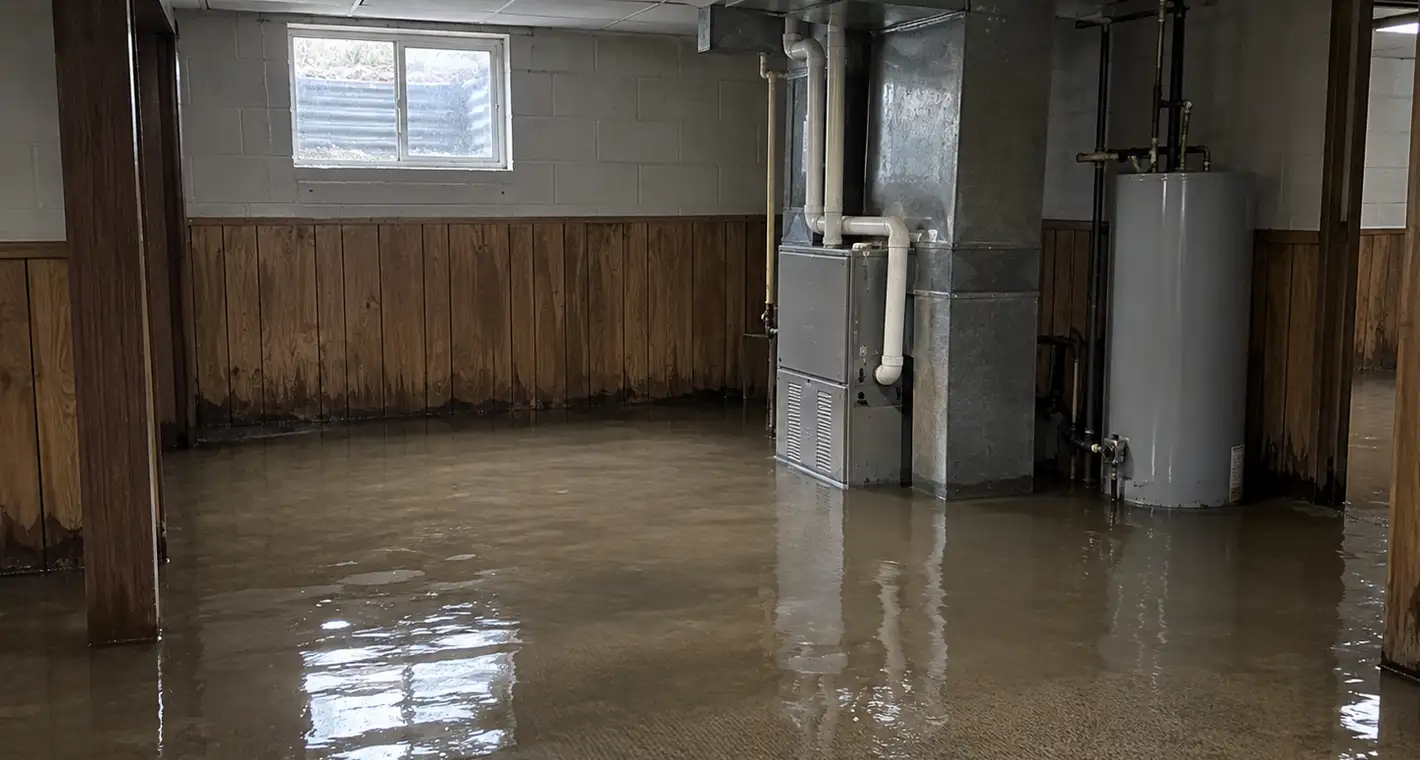
Emergency water removal Dearborn Heights: the ground it sits on
Dearborn Heights runs north to south across two separate drainage systems: the Rouge River and Hines Drive at the north end of the city, the North Branch of Ecorse Creek at the bottom. Two thirds of the housing here went up in the 1940s and 1950s, and the median build year is 1958, so most basements are block walls poured before modern drain tile.
Burst pipe cleanup Dearborn Heights: where the water comes from
The Rouge River and Hines Park
Hines Park was laid out along the Middle Rouge as a floodway, and it does its job: when the gauge at Dearborn Heights comes up, the park floods and Hines Drive closes. The homes north of Van Born and near the river take the same water at the same time. In the worst events streets in that end of the city have gone under several feet, with water at the doorways.
Ecorse Creek at the south end
The North Branch of Ecorse Creek drains 30 square miles through nine cities and has severely limited hydraulic capacity, which Wayne County is now addressing with a 16-mile cleanup of the drain. Until that capacity improves, storm sewers on the south side of the city cannot discharge fast enough during a heavy rain, and the water backs up into footing drains and basements instead.
Combined sewer backup in the older district
Inside the 548-acre combined district, sewage and storm water share one pipe. Once the retention basin on Hines Drive is full, the system has nowhere left to put the flow, and it pushes back toward the houses. It arrives through the floor drain and the laundry standpipe, and it is contaminated water from the first minute, which changes what can be dried and what has to be removed.
Clay that holds water against the wall
This is glacial lake plain, and the clay under it drains very slowly. After a heavy rain the backfill around a foundation stays saturated for days, which keeps hydrostatic pressure on the wall long after the sky clears. On block walls poured in the 1950s that pressure finds the mortar joints, and seepage shows up at the base of the wall two days after the storm that caused it.
Before help arrives
- Shut the water off at the fixture or the main if you can reach it safely.
- Keep out of any room where water has reached outlets, cords, or the electrical panel.
- Lift furniture off wet carpet and move what you can to a dry floor.
- Photograph the damage and the failure point before anything is moved.
- Do not use a household vacuum to pick up standing water.
Sewage backup cleanup Dearborn Heights: the pipe under the street
A 548-acre district in this city is still served by combined sewers, and Wayne County built a retention basin on Hines Drive in 1997 to hold what overflows: three parallel tanks totaling 2.7 million gallons, with anything past that screened, settled, disinfected and sent to the Rouge. The rest of the city drains through separated pipes into the Rouge Valley system. Which side of that line your street falls on decides whether a downpour reaches your floor drain.
Water extraction Dearborn Heights and drying what is left
The north end has walkout and partial-walkout basements cut into the river bank, which take water at the wall rather than through the slab, and wet block wicks upward for days after the visible water is gone. Readings are taken at several heights on the same wall, because a block wall that reads dry at four feet can still be saturated at eighteen inches.
Mold remediation Dearborn Heights when drying came too late
Mold remediation in Dearborn Heights is usually a north-end job, in a basement that took river or ground water at the wall and was dried by opening a window. Block cores hold moisture long after the room feels normal, and growth starts on the paper face of anything fastened to that block.
Water Damage Restoration Dearborn Heights MI: what providers handle
- Water Extraction & DryingWater pulled out of carpet, subfloor and wall cavities, then dried under daily meter readings.
- Flooded Basement CleanupWater below grade: a pump that stopped, seepage through the wall, or a drain that backed up.
- Sewage Backup CleanupDrain water treated as contaminated: containment, removal, cleaning and disinfection.
- Mold RemediationGrowth that took hold while a wet cavity stayed wet. Contained removal, not surface cleaning.
Areas covered in Dearborn Heights
Providers cover Dearborn Heights and the surrounding area, including the Warren Valley area, Crestwood, the north end near Hines Drive, the Beech Daly corridor, the Van Born corridor and the Ecorse Road corridor.
ZIP codes: 48125, 48127.
Water Damage Restoration Dearborn Heights MI: questions homeowners ask
- Will my homeowners insurance cover water damage?
- It depends on the cause rather than the damage. Policies commonly cover sudden and accidental events such as a burst supply line, a failed water heater, or an appliance hose that lets go. Damage that developed gradually from a long-standing leak, and damage from surface flooding, are usually handled differently or excluded. Photograph everything before anything is moved, keep any failed part, and report the loss promptly.
- Why does the north end of Dearborn Heights flood differently from the south?
- They are on two different water systems. North of Van Born the ground drains toward the Rouge River and Hines Park, which floods by design when the river comes up. South of there everything drains to the North Branch of Ecorse Creek, which is a slow, capacity-limited channel. The north end sees river water; the south end sees water that cannot leave.
- Water came in at the wall, not the floor drain. What does that mean?
- It usually means the source was outside rather than in the sewer: saturated backfill pressing on the wall, a failed or undersized footing drain, or surface water finding a way down along the foundation. That is a different repair path and often a different insurance answer than a sewer backup, so it is worth photographing where the water actually entered before anything is moved.
- Does the retention basin on Hines Drive protect my house?
- It protects the river more than it protects any one basement. The basin holds 2.7 million gallons of overflow and treats what it releases, which keeps untreated sewage out of the Rouge. It buys the collection system time during a moderate storm, but in a storm past its design the system still backs up, and it backs up toward the buildings connected to it.