
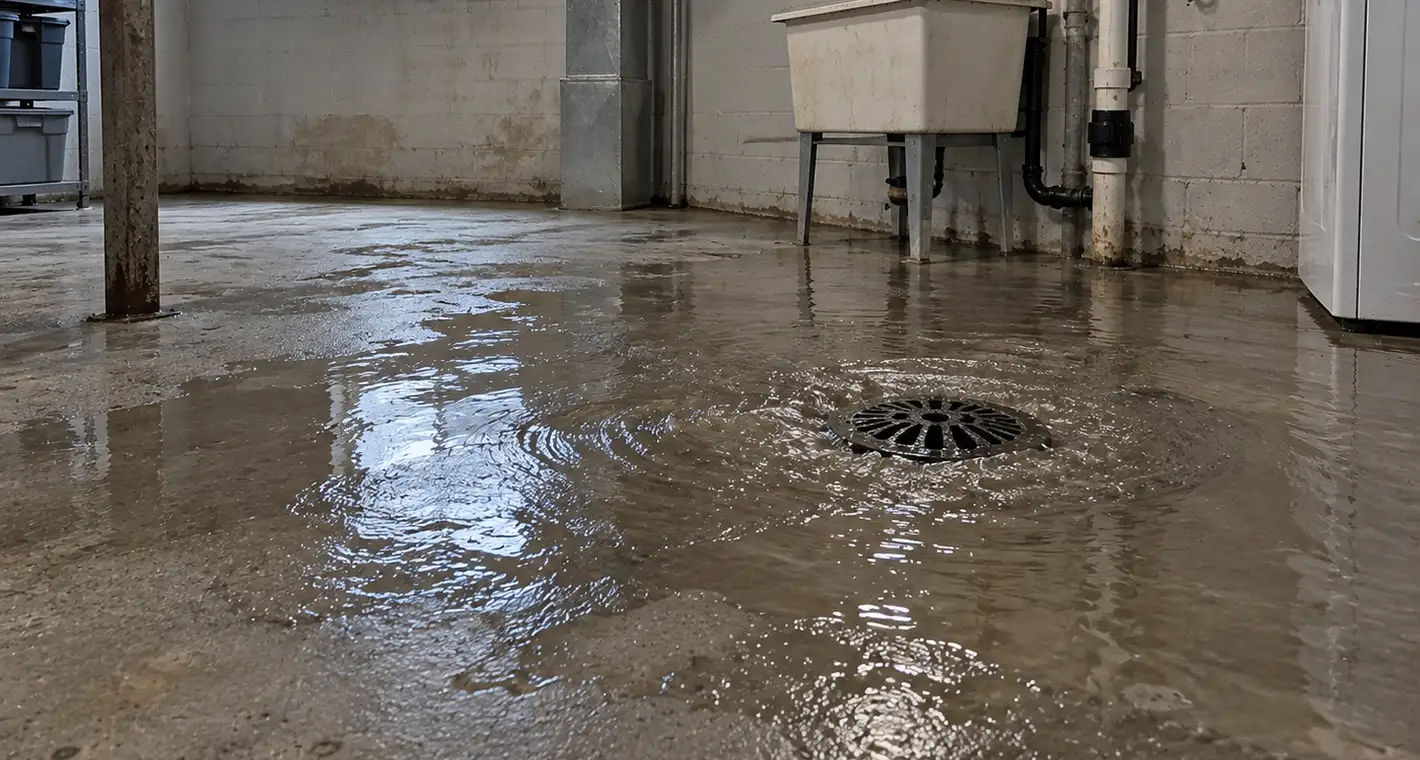
Keep out of the affected area
- Keep children and pets away from the area entirely.
- Do not run fans in the space. Moving air spreads contamination through the house.
- Do not attempt to extract it with household equipment.
- Avoid using drains and fixtures on that line until the cause is identified.
- Photograph the extent before anything is moved.
Why a sewage backup is a different job
With clean water the problem is moisture and the goal is to get materials back to normal. With sewage, moisture is the second problem. The water carries bacteria and organic material that soak into porous surfaces and stay there after the water is gone. Extracting and drying a carpet that has been through a backup returns it to normal moisture and leaves the contamination exactly where it was.
That one fact drives everything else. The question is not what can be dried, it is what can be cleaned all the way through. Material that can only be cleaned on the surface comes out.
Where these backups come from in western Wayne and Downriver
Combined sewers that are still in service
Wyandotte is served entirely by combined sewers, all 2,772 acres of it. Southgate has roughly 1,046 acres combined against 1,443 separated. Dearborn Heights has a 548-acre combined district with a county retention basin behind it, and Dearborn has been splitting its own single-line system in two under a federal mandate. Where the pipe is still shared, a heavy rain fills it with street water and the flow reverses toward the houses.
Clay tile laterals under mature trees
The line from the house to the street in a pre-1960 neighborhood is usually clay tile in short sections with mortared joints, and these cities have the tree canopy to match. Roots enter at the joints, the effective diameter shrinks, and a lateral that carries household flow perfectly well chokes the moment storm infiltration is added to it.
Storm water getting into separated sanitary lines
In Livonia, Garden City, Westland, Wayne and Romulus there are no combined sewer regulators, but the sanitary system still sees storm flow through cracked pipe, bad joints and downspouts or sump lines connected where they should not be. That infiltration peaks during exactly the storms that raise the water table, which is why separated cities also get backups on the same nights.
How the work proceeds
The area is contained before anything is removed. Openings to the rest of the house are sheeted off and the work zone is put under negative pressure, so air flows into it and is filtered on the way out rather than carrying contamination into clean parts of the home. Skip this and the removal itself distributes the problem through the house.
Affected porous material is then removed and bagged: carpet and padding, the lower band of drywall, wet insulation, particleboard, and laminate or engineered flooring. Non-porous material such as concrete, tile, sealed hardwood and structural framing can usually be cleaned and kept, because contamination stays on the surface where it can be reached. In a basement that is most of the room, which is why a backup on a slab often saves more of the structure than the same water upstairs.
Cleaning follows removal, and only after cleaning does the structure get dried in the ordinary way, with air movers and dehumidification under moisture readings. Drying before cleaning would set contamination into the materials being dried.
Sewage Cleanup Dearborn MI: cities covered
- Sewage Backup Cleanup Dearborn
- Sewage Backup Cleanup Dearborn Heights
- Sewage Backup Cleanup Wyandotte
- Sewage Backup Cleanup Melvindale
- Sewage Backup Cleanup Lincoln Park
- Sewage Backup Cleanup Allen Park
- Sewage Backup Cleanup Southgate
- Sewage Backup Cleanup Taylor
- Sewage Backup Cleanup Livonia
- Sewage Backup Cleanup Westland
- Sewage Backup Cleanup Garden City
- Sewage Backup Cleanup Wayne
- Sewage Backup Cleanup Romulus
- Sewage Backup Cleanup Trenton
- Sewage Backup Cleanup Riverview
- Sewage Backup Cleanup Woodhaven
Sewage Cleanup Dearborn MI: questions homeowners ask
- The water looked clear. Is it still treated as sewage?
- Yes. Water that came up through a floor drain or a laundry standpipe has been inside a pipe that carries waste, and in a combined sewer it has also been in the street. Appearance says nothing about what is in it. The category is set by where the water came from, not by how it looks, and it determines what can be cleaned and kept.
- Whose problem is it, mine or the city's?
- It depends on where the restriction is. Most Michigan communities hold the property owner responsible for the lateral on private ground and the city responsible for the main. From inside the basement a root-blocked private lateral and a surcharged city main look identical, which is why a camera inspection after cleanup is worth the cost. Your city's water department can tell you where the line of responsibility falls.
- Why does this happen during heavy rain and not otherwise?
- In the cities still on combined sewers, rain and sewage share one pipe, so a downpour fills it in minutes and the flow reverses toward the buildings. In the cities with separated sewers the mechanism is infiltration: storm water leaking into cracked sanitary lines and old laterals adds to household flow until the line cannot carry it. Both peak during the same storms.
- Can carpet or a finished basement wall be saved?
- Hard, non-porous material can be cleaned and kept: concrete, tile, sealed hardwood, framing. Porous material in the wet zone comes out, which usually means carpet and pad, the lower band of drywall or paneling, insulation behind it, particle board, and stored cardboard. It is not a judgment about how dirty it looks; porous material cannot be cleaned all the way through.
- How long before it is safe to use the space again?
- Removal and cleaning are usually a day for a contained loss, with drying running several days after that. The space is not returned to normal use until the affected material has been removed, the remaining surfaces cleaned and disinfected, and moisture readings match dry material elsewhere in the house. Rushing that sequence is what turns a backup into a mold job.