
Emergency water removal Taylor: the ground it sits on
Taylor covers about 24 square miles of level lake plain, with the North Branch of Ecorse Creek running across the city and Heritage Park sitting on the low ground beside it. Taylor's stock is postwar and suburban, with a median build year of 1963 and just over half of it put up in the 1940s and 1950s.
Burst pipe cleanup Taylor: where the water comes from
Twenty-four square miles with no fall
Taylor is about as flat as land gets in this part of Michigan. Storm water does not run anywhere on its own; it either soaks into clay that takes it slowly or it waits for a pipe. During a heavy rain that means standing water on streets and lawns for hours, which keeps the ground around every foundation in the city saturated at the same time.
The creek and Heritage Park
The North Branch of Ecorse Creek crosses the city and the low ground beside it includes Heritage Park. Homes near that corridor are the first to feel the channel's capacity limit, and the effect reaches further than the mapped floodplain: it is not that the creek comes over the bank onto a street, it is that the pipes serving streets a half-mile away cannot empty into it.
Sump pumps as standard equipment
In a city where nearly every house has a full basement in clay, the sump pump is not an accessory. Pumps installed with the house are decades past their service life, and a float switch that sticks fails silently until the storm that needed it. A quarter of Michigan households have also gone a full day without power, and a pump without a battery behind it is off during exactly that window.
Washing machine and dishwasher lines
Rubber supply hoses on a washer have a service life measured in years, and they usually fail at the crimp rather than in the middle. On a laundry set in a basement that is a modest cleanup. On a first-floor laundry, which many of the later Taylor houses have, the water goes down through the floor into the ceiling below and spreads along the joists before anything shows.
Before help arrives
- Shut the water off at the fixture or the main if you can reach it safely.
- Keep out of any room where water has reached outlets, cords, or the electrical panel.
- Lift furniture off wet carpet and move what you can to a dry floor.
- Photograph the damage and the failure point before anything is moved.
- Do not use a household vacuum to pick up standing water.
Sewage backup cleanup Taylor: the pipe under the street
Taylor is one of the nine cities in the North Branch Ecorse Creek drainage district, which covers about 19,200 acres and 48,000 parcels. Wayne County describes the North Branch as severely limited hydraulically and has started a 16-mile cleanup of the channel. In a city this flat, that limit is felt directly: there is no gradient to push water toward the creek, so when the creek is full the storm system stalls and the water stays in the ground.
Water extraction Taylor and drying what is left
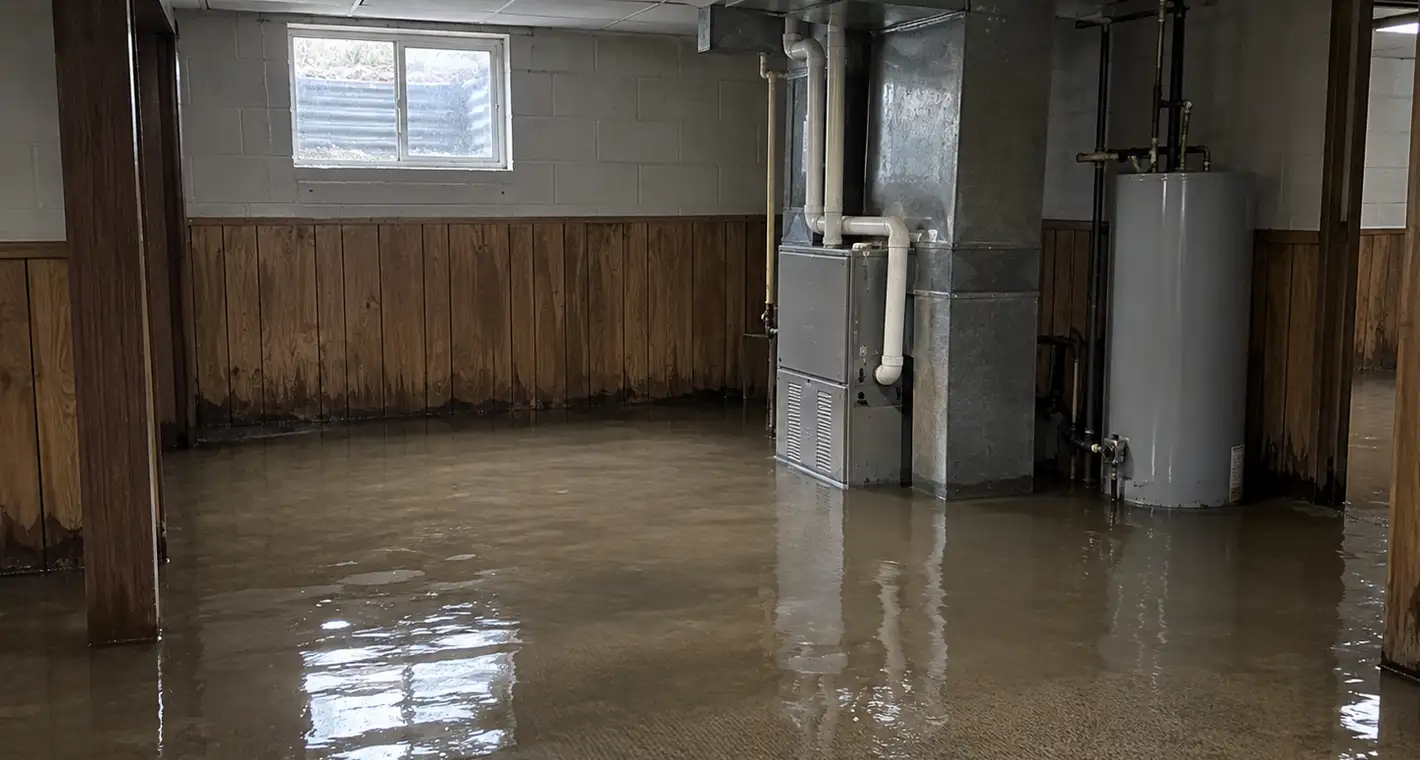
A lot of Taylor's houses are ranches on full basements with the utilities in the open and the rest finished as one large room. That layout dries reasonably well when the water was clean, because air can move the length of the space. The complication is usually the storage along the walls, which has to come out before the walls can be reached at all.
Mold remediation Taylor when drying came too late
Mold remediation in Taylor is most often about time rather than the size of the loss. A large basement that took two inches of water and was pushed out with a squeegee still has wet pad, wet drywall base and wet storage, and forty-eight hours in a warm basement is enough for growth to establish on the paper faces.
Water Damage Restoration Taylor MI: what providers handle
- Water Extraction & DryingWater pulled out of carpet, subfloor and wall cavities, then dried under daily meter readings.
- Flooded Basement CleanupWater below grade: a pump that stopped, seepage through the wall, or a drain that backed up.
- Sewage Backup CleanupDrain water treated as contaminated: containment, removal, cleaning and disinfection.
- Mold RemediationGrowth that took hold while a wet cavity stayed wet. Contained removal, not surface cleaning.
Areas covered in Taylor
Providers cover Taylor and the surrounding area, including the Heritage Park area, the Telegraph Road corridor, the Eureka Road corridor, the Goddard Road corridor, the Pardee Road area and the Van Born corridor.
ZIP codes: 48180.
Water Damage Restoration Taylor MI: questions homeowners ask
- Will my homeowners insurance cover water damage?
- It depends on the cause rather than the damage. Policies commonly cover sudden and accidental events such as a burst supply line, a failed water heater, or an appliance hose that lets go. Damage that developed gradually from a long-standing leak, and damage from surface flooding, are usually handled differently or excluded. Photograph everything before anything is moved, keep any failed part, and report the loss promptly.
- Water is standing on the street but not in my Taylor basement yet. What should I do?
- Take the fifteen minutes it gives you. Move stored goods off the floor, get anything electrical up off the slab, and make sure the sump discharge outside is clear and pointed away from the house. If you have a backwater valve, know where it is. If water does come in, that head start is usually the difference between drying the room and removing part of it.
- My pump has never failed in twenty years. Is it worth replacing?
- A pump that old is running past its design life and its float is the part that goes first, usually by sticking rather than by burning out. The failure is silent: nothing tells you until the pit is full. Replacing it before a storm is inexpensive relative to a basement, and adding a battery backup addresses the outage problem that no pump on house current can.
- How long does a large finished basement take to dry in Taylor?
- Four to seven days is typical for a big open space where the pad is out and the drywall base has been cut. The size works in your favor for airflow and against you for the amount of material holding water. Readings decide when it is finished, not the calendar, and they are taken at the same points each day so the trend is visible.