
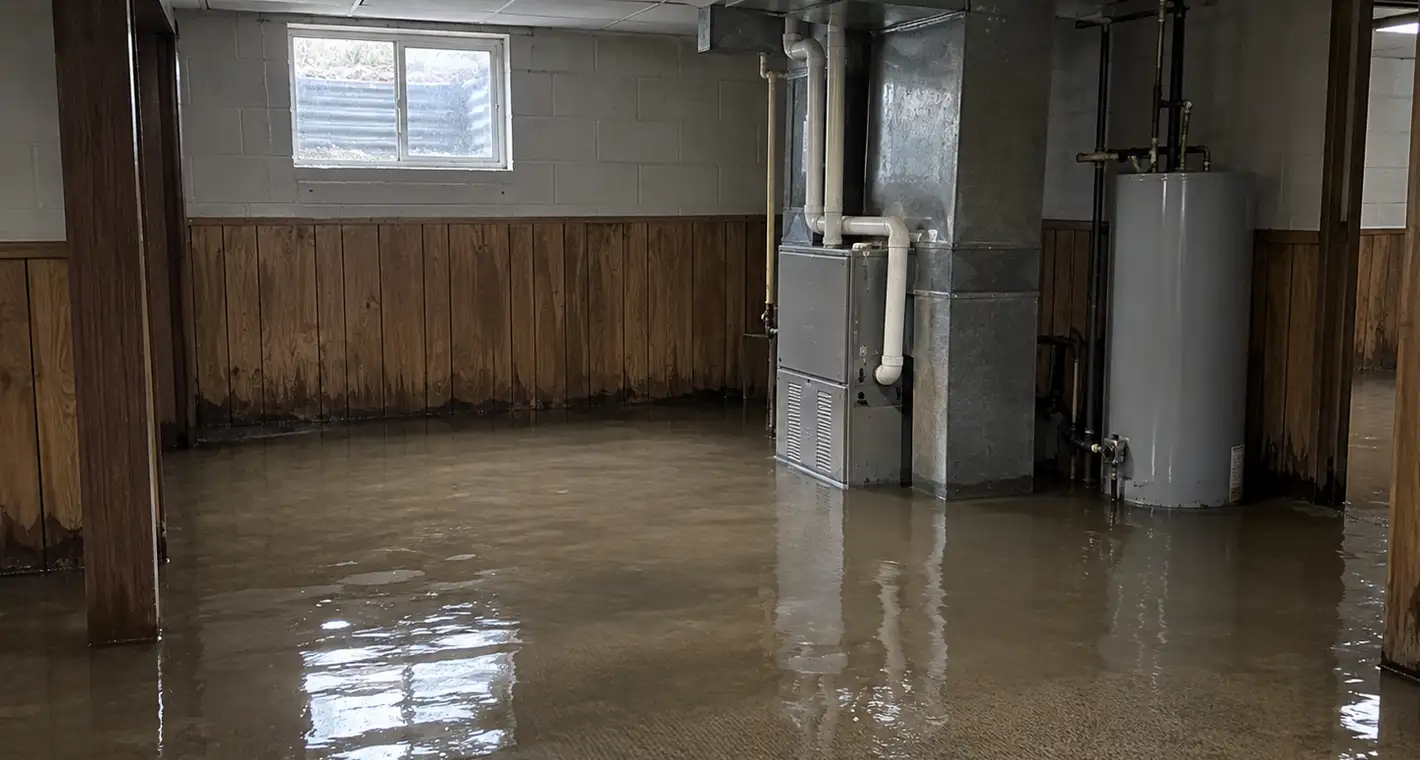
Why basements flood here and not somewhere else
This is glacial lake plain. The ground under western Wayne County and Downriver is lacustrine clay, more than a hundred feet thick as you approach Lake Erie, and it drains very slowly. There is also almost no fall: from Livonia to the Detroit River the land drops so little that storm water does not run off, it waits for a pipe. Two shallow channels carry most of it, the Rouge River across the north of the region and Ecorse Creek across the south, and Wayne County has said in writing that the North Branch of Ecorse Creek is severely limited in capacity. Sixty-two percent of Michigan homes have a basement, against thirty percent nationally, so the part of the house that meets all of this is a finished room rather than a crawl space.
The dividing line between one city and the next is the sewer. Wyandotte is served entirely by combined sewers, one pipe carrying both the sewage and the street water; Southgate is split, with roughly 1,046 acres combined and 1,443 separated; Dearborn has been splitting its own single-line system in two under a federal mandate. Where the pipe is shared, a heavy rain reverses it and the water arrives through the floor drain. Where it is not, the water arrives through the wall or the slab instead. On the night of 25 June 2021 six to seven inches of rain fell across the metro in twelve hours; more than twelve thousand Dearborn homes were documented with flood damage and a presidential disaster declaration followed for Wayne County. A quarter of Michigan households have also gone a full day or longer without power, which is when a sump pump stops.
Emergency water removal, then drying under measurement
Removing the water you can see is the beginning rather than the end. It moves by gravity and capillary action into carpet padding, under vinyl and laminate, through baseboard into wall cavities, and along framing into rooms that were never wet on the surface. A floor that feels dry underfoot can still be holding enough water in the subfloor to keep the structure wet for weeks.
Extraction pulls water out of carpet and padding rather than off the surface. Air movers and dehumidifiers then work together, one moving water out of materials and the other taking it out of the air, under daily meter readings. Material that cannot be brought back is removed instead: pad, the bottom band of drywall, wet insulation. The extraction and drying page covers how that is measured, and why a February loss and a July loss are not the same job here.
Before help arrives
- Shut the water off at the fixture or the main if you can reach it safely.
- Keep out of any room where water has reached outlets, cords, or the electrical panel.
- Lift furniture off wet carpet and move what you can to a dry floor.
- Photograph the damage and the failure point before anything is moved.
- Do not use a household vacuum to pick up standing water.
water damage restoration Dearborn MI: the four things providers are called for
- Water Extraction & DryingWater pulled out of carpet, subfloor and wall cavities, then dried under daily meter readings.
- Flooded Basement CleanupWater below grade: a pump that stopped, seepage through the wall, or a drain that backed up.
- Sewage Backup CleanupDrain water treated as contaminated: containment, removal, cleaning and disinfection.
- Mold RemediationGrowth that took hold while a wet cavity stayed wet. Contained removal, not surface cleaning.
water damage restoration Dearborn MI: cities covered
- Water Damage Restoration DearbornZIP 48120, 48124, 48126, 48128
- Water Damage Restoration Dearborn HeightsZIP 48125, 48127
- Water Damage Restoration WyandotteZIP 48192
- Water Damage Restoration MelvindaleZIP 48122
- Water Damage Restoration Lincoln ParkZIP 48146
- Water Damage Restoration Allen ParkZIP 48101
- Water Damage Restoration SouthgateZIP 48195
- Water Damage Restoration TaylorZIP 48180
- Water Damage Restoration LivoniaZIP 48150, 48152, 48154
- Water Damage Restoration WestlandZIP 48185, 48186
- Water Damage Restoration Garden CityZIP 48135
- Water Damage Restoration WayneZIP 48184
- Water Damage Restoration RomulusZIP 48174
- Water Damage Restoration TrentonZIP 48183
- Water Damage Restoration RiverviewZIP 48193
- Water Damage Restoration WoodhavenZIP 48183
water damage restoration Dearborn MI: questions homeowners ask
- Will my homeowners insurance cover water damage?
- It depends on the cause rather than the damage. Policies commonly cover sudden and accidental events: a burst supply line, a failed water heater, an appliance hose that lets go. Damage that developed gradually from a long-standing leak, and damage from surface flooding, are usually handled differently or excluded. Photograph everything before anything moves, keep any failed part, and report promptly.
- What does water damage restoration cost?
- Cost tracks the size of the wet area, how long the water sat, whether it was clean or contaminated, and how much material comes out rather than being dried. Expect a walk-through and a written scope before work starts, rather than a number over the phone.
- How fast can someone reach my property?
- This is a compact region with good roads. I-94, I-75, the Southfield Freeway, Telegraph and Michigan Avenue put most of these sixteen cities within twenty to thirty minutes of each other, with Woodhaven at the southern edge and Romulus out by the airport the two far ends. The real variable is demand rather than distance: a storm that fills basements in Dearborn fills them in Taylor and Lincoln Park the same hour, and every provider is dispatching at once. Calling early in an event matters more than being close to one.
- Is a flooded basement handled differently from an upstairs leak?
- In two ways. Water that came in through a floor drain or through the ground is treated as contaminated, which lowers what can be saved. And the equipment works against a slab and masonry that hold water far longer than framing does, so a basement takes longer to reach a normal reading.
- What is the difference between water damage restoration and mold remediation?
- Restoration deals with the water: removing it, drying the structure, returning materials to normal moisture. Remediation deals with growth that has already established, under containment, with removal and cleaning rather than drying. Water handled quickly usually prevents the second job entirely.
- Who are the providers on this site?
- They are independent restoration contractors working across western Wayne and Downriver. This site is not a contractor and performs no restoration work. It connects homeowners with providers in their area, and verifying that the contractor they hire carries the license and insurance the work requires is the homeowner's responsibility.