
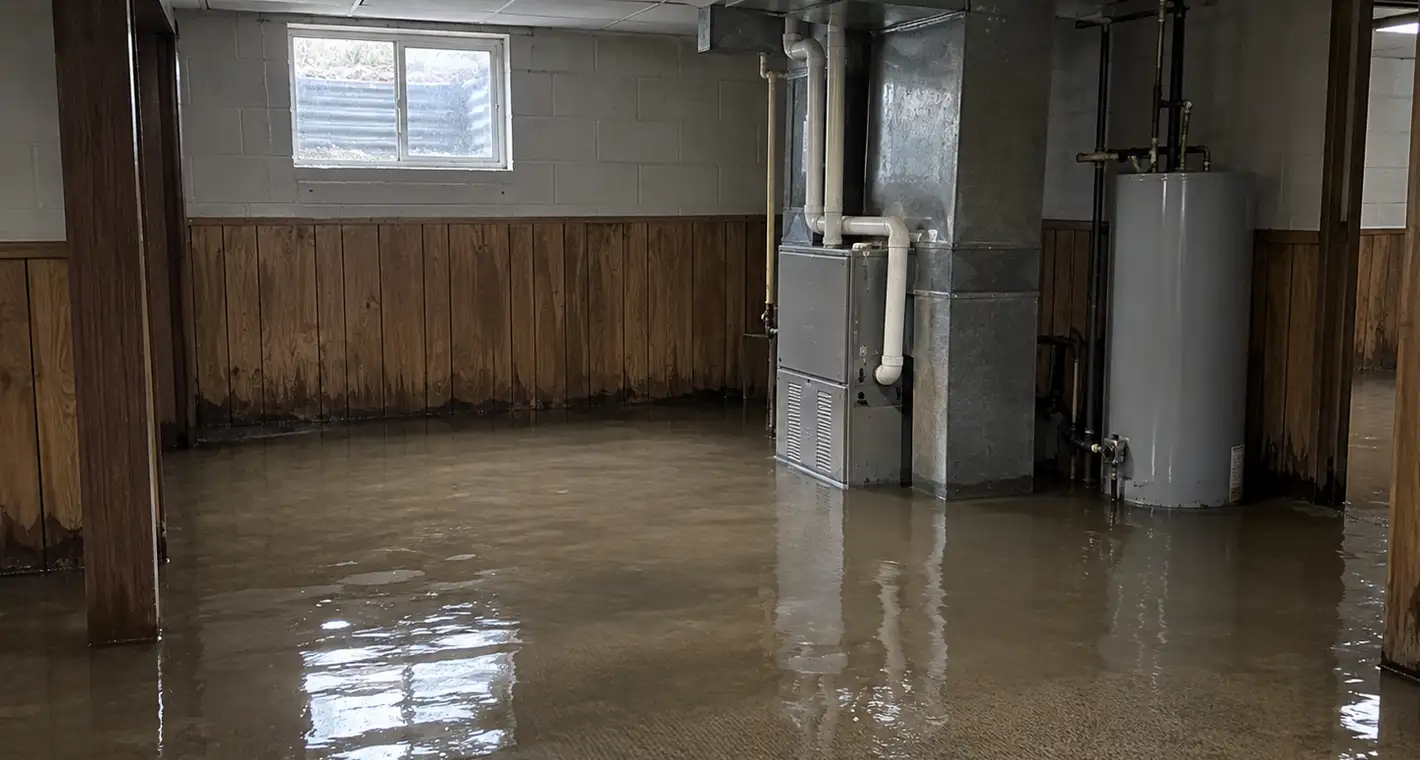
Emergency water removal Wayne: the ground it sits on
Wayne sits on the Michigan Avenue corridor with the Lower Rouge River crossing the city, on flat ground that gives the river a wide, slow floodplain. Just under 30 percent of Wayne's houses predate 1940 and the median build year is 1958, an unusually wide spread for a city of four square miles.
Burst pipe cleanup Wayne: where the water comes from
The Lower Rouge through the city
The Lower Rouge crosses Wayne on its way from Canton toward Dearborn Heights, through ground flat enough that the floodplain is wide and the river spreads rather than rising fast. Properties near the corridor see a slow arrival: the ground water table comes up over hours, the footing drains stop draining, and the basement takes water without a drop coming over any bank.
Nineteenth and early twentieth century foundations
Three houses in ten here predate 1940, and a share of those predate the 1920s. Their below-grade walls are stone or early block, laid without any waterproofing on the outside face and without drain tile at the footing. These walls take water through the material itself, which is why the room stays humid for days after the floor is dry.
Freeze-thaw on old masonry
Michigan winters put a foundation through dozens of freeze-thaw cycles, and each one works at the mortar joints of an old wall. Water that got into a joint in November is ice in January and a wider joint in March. It is a slow mechanism, but it explains why a wall that seeped a little five years ago seeps considerably more now without anything else having changed.
Frozen supply lines in unheated additions
Older Wayne houses have accumulated rear additions, enclosed porches and detached garages, and the plumbing that reaches them often runs through spaces with no heat. Those runs are the ones that split during a hard freeze. The break itself is small; the damage comes from the hours or days before somebody notices and closes the main.
Before help arrives
- Shut the water off at the fixture or the main if you can reach it safely.
- Keep out of any room where water has reached outlets, cords, or the electrical panel.
- Lift furniture off wet carpet and move what you can to a dry floor.
- Photograph the damage and the failure point before anything is moved.
- Do not use a household vacuum to pick up standing water.
Sewage backup cleanup Wayne: the pipe under the street
Wayne's sanitary sewer runs into the Rouge Valley system, and the combined sewer regulators in that system belong to Dearborn Heights, Inkster and Redford, not to this city. Street water leaves separately toward the Lower Rouge. What that means in practice is that when a Wayne basement takes water during a storm, the cause is almost always outside the pipes: the river, the water table, or roof and surface water that found a way down beside the wall.
Water extraction Wayne and drying what is left
Pre-1940 houses in Wayne have shallow basements with stone or early block, and postwar houses on the same street have full poured foundations. The two dry at different rates, and the older ones hold moisture in the masonry long after the newer ones read dry. Meters go into the wall material rather than reading off the surface, particularly on the older half of the stock.
Mold remediation Wayne when drying came too late
Mold remediation in Wayne is frequently in the oldest houses, where a basement was never meant to be living space and later became one. Framing set against damp stone with insulation behind it is the classic finding, and the growth is between the framing and the wall where nobody has looked in thirty years.
Water Damage Restoration Wayne MI: what providers handle
- Water Extraction & DryingWater pulled out of carpet, subfloor and wall cavities, then dried under daily meter readings.
- Flooded Basement CleanupWater below grade: a pump that stopped, seepage through the wall, or a drain that backed up.
- Sewage Backup CleanupDrain water treated as contaminated: containment, removal, cleaning and disinfection.
- Mold RemediationGrowth that took hold while a wet cavity stayed wet. Contained removal, not surface cleaning.
Areas covered in Wayne
Providers cover Wayne and the surrounding area, including the Michigan Avenue corridor, the Wayne Road corridor, the Old Village area, the Lower Rouge corridor, the Annapolis Street area and the Glenwood Road area.
ZIP codes: 48184.
Water Damage Restoration Wayne MI: questions homeowners ask
- Will my homeowners insurance cover water damage?
- It depends on the cause rather than the damage. Policies commonly cover sudden and accidental events such as a burst supply line, a failed water heater, or an appliance hose that lets go. Damage that developed gradually from a long-standing leak, and damage from surface flooding, are usually handled differently or excluded. Photograph everything before anything is moved, keep any failed part, and report the loss promptly.
- How can the river flood my basement if it never left its banks?
- It does not have to. When the Lower Rouge is high, the water table in the ground beside it rises with it, and a footing drain that normally carries water away has nowhere to send it. The basement takes water from below and from the wall while the river stays where it is. Riverside properties in Wayne see this more often than they see actual overbank flooding.
- Can a stone foundation wall be dried, or does it have to be replaced?
- It can almost always be dried. Stone and old mortar hold water in the material and give it up slowly, so it takes longer and needs directed airflow and enough dehumidification to keep pulling. What usually has to come out is whatever was fastened to the wall: framing, insulation and finish, because those hold water against the masonry and slow the whole job down.
- My house is from 1925 and my neighbor's is from 1958. Why did only mine flood?
- Depth and construction. The older foundation is likely shallower, built without exterior waterproofing and without a drain at the footing, so it meets ground water sooner and has no path to shed it. On the same street in the same storm, a thirty-year difference in build date frequently decides which basement stays dry.