
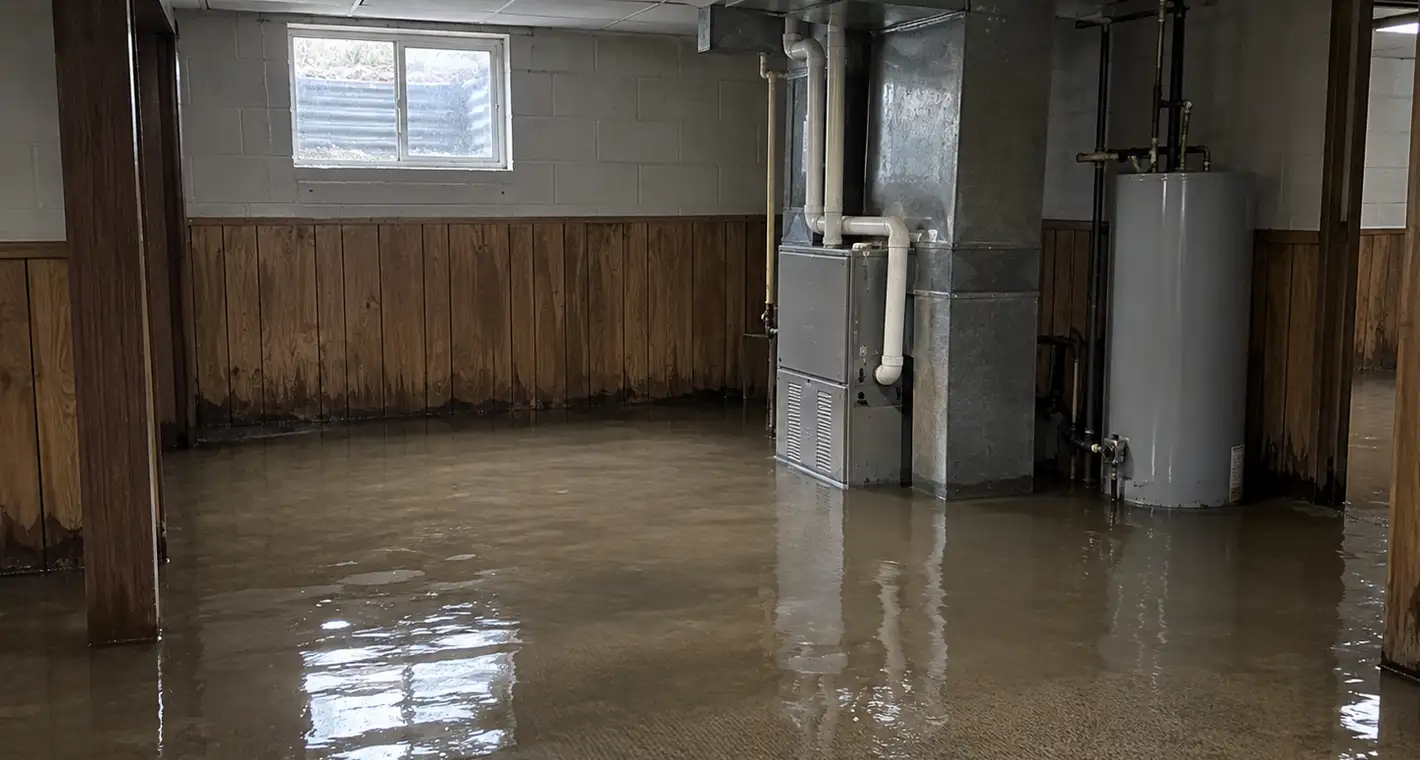
Emergency water removal Woodhaven: the ground it sits on
Woodhaven sits west of the Detroit River on former farmland at the southern end of the Downriver communities, drained by the Frank and Poet and Silver Creek systems toward Lake Erie. Woodhaven is the newest stock covered here: a median build year of 1979, 37 percent built in 1980 or later, and only 3.5 percent predating 1940.
Burst pipe cleanup Woodhaven: where the water comes from
Everything depends on the pump
A foundation built in 1979 with drain tile at the footing is dry because water is collected and pumped out, continuously and invisibly. That is a better system than an undrained block wall, right up until the pump stops. There is no second path: what the tile collects has nowhere to go, the pit overflows, and the water enters through the pit and the floor drain.
Storms and outages arriving together
A quarter of Michigan households have gone 24 hours or more without power, and the storms that cause those outages are the same ones that put the most water into the ground. In a house where the drainage is the pump, that is the exact hour it is not running. A battery backup or a water-powered backup is the only thing that covers that window.
Finished lower levels in full use
Because these basements stay dry, they get finished and lived in: carpet, drywall, cabinetry, electronics, storage that is not in boxes. When water does arrive it reaches all of it at once. The loss is rarely structural and frequently expensive, and the first hours are spent getting contents out rather than getting equipment in.
Polybutylene and early plastic supply
A slice of the housing built between the late 1970s and the mid 1990s was plumbed with materials that have not aged well, polybutylene among them. These fail without warning at fittings rather than in the middle of a run, and they fail under normal pressure. If a house of this vintage has never been repiped, it is worth knowing what is in the walls before it tells you.
Before help arrives
- Shut the water off at the fixture or the main if you can reach it safely.
- Keep out of any room where water has reached outlets, cords, or the electrical panel.
- Lift furniture off wet carpet and move what you can to a dry floor.
- Photograph the damage and the failure point before anything is moved.
- Do not use a household vacuum to pick up standing water.
Sewage backup cleanup Woodhaven: the pipe under the street
Woodhaven was laid out after separated storm and sanitary sewers were the standard, so the combined sewer problem that defines the older Downriver cities does not exist here. Its drainage runs to the Frank and Poet and Silver Creek systems toward Lake Erie. What is left is the trade the modern approach makes: foundations that stay dry because a pump keeps them dry, and no passive fallback when that pump stops.
Water extraction Woodhaven and drying what is left
Foundations here are poured concrete with drain tile and a vapor barrier under the slab, so the structure itself gives up water quickly and readings come down on schedule. The material that holds water is what was added: carpet and pad, finished walls in a lower level, and cabinetry set on the slab in a basement kitchen or bar.
Mold remediation Woodhaven when drying came too late
Mold remediation in Woodhaven is uncommon relative to the older cities and almost always follows a loss that sat. A modern basement does not have a chronic damp wall to grow on, so growth here means a specific event went unaddressed for several days, typically while the house was empty.
Water Damage Restoration Woodhaven MI: what providers handle
- Water Extraction & DryingWater pulled out of carpet, subfloor and wall cavities, then dried under daily meter readings.
- Flooded Basement CleanupWater below grade: a pump that stopped, seepage through the wall, or a drain that backed up.
- Sewage Backup CleanupDrain water treated as contaminated: containment, removal, cleaning and disinfection.
- Mold RemediationGrowth that took hold while a wet cavity stayed wet. Contained removal, not surface cleaning.
Areas covered in Woodhaven
Providers cover Woodhaven and the surrounding area, including the West Road corridor, the Allen Road corridor, the Van Horn Road corridor, the Gudith Road area, the Hall Road area and the King Road area.
ZIP codes: 48183.
Water Damage Restoration Woodhaven MI: questions homeowners ask
- Will my homeowners insurance cover water damage?
- It depends on the cause rather than the damage. Policies commonly cover sudden and accidental events such as a burst supply line, a failed water heater, or an appliance hose that lets go. Damage that developed gradually from a long-standing leak, and damage from surface flooding, are usually handled differently or excluded. Photograph everything before anything is moved, keep any failed part, and report the loss promptly.
- My Woodhaven basement has never been wet. Do I need a backup pump?
- That is exactly the profile that argues for one. A basement that has never been wet is not dry by luck, it is dry because the pump has never missed. The risk is not that the system is weak, it is that it is the only system, and it runs on the power that storms take out. A battery backup covers the case where the primary pump has done nothing wrong.
- Can newer construction still get mold?
- Yes, but for a different reason. Older houses grow mold from chronic dampness; newer ones grow it from a single event that was not dried in time. Modern assemblies are tighter, which means a wet wall cavity dries more slowly on its own once water gets in. Two or three days is enough, and a house that was empty during that window is the usual story.
- How do I tell whether my house has polybutylene supply lines?
- It is usually gray or blue-gray flexible pipe, roughly half an inch, with crimped metal or plastic fittings, and it is most visible where lines enter the water heater or at exposed runs in the basement. A plumber can identify it in a few minutes. If the house was built or plumbed between the late 1970s and mid 1990s and has never been repiped, it is worth checking.